Welcome to the BCIT Animal Care and Use Program website. This website provides information about the humane and ethical use of animals in research and teaching and the BCIT Animal Care and Use Program that ensures this occurs. BCIT faculty and other animal users can also find forms and resources needed to support a request to use animals, in addition to polices, standard operating procedures, and related documentation.
Program Overview
Animals have and continue to play a critical role in teaching and research, helping to generate knowledge and support decision making. BCIT recognizes that the use of animals is a privilege, not a right, and requires that all programs that use animals for teaching or research (including field studies) follow strict guidelines and policies established by the Canadian Council on Animal Care (CCAC), BCIT itself, and the BCIT Animal Care Committee (BCIT-ACC) to ensure the ethical and humane treatment of all animals.
Interactions with and use of animals at BCIT are limited, with most related to teaching and training. Some research involving animals does occurs and, as a result, BCIT must be accredited by the CCAC to receive federal funding. BCIT has held a CCAC Good Animal Practice (GAP) Certificate since 2026 and the CCAC conducts assessments every three years to evaluate the effectiveness of the animal care program and identify areas for improvement. If the Institute fails to comply with the CCAC policies and guidelines, the CCAC has the legal authority to immediately suspend BCIT’s Animal Care and Use Program and GAP Certificate.
Application and approval process
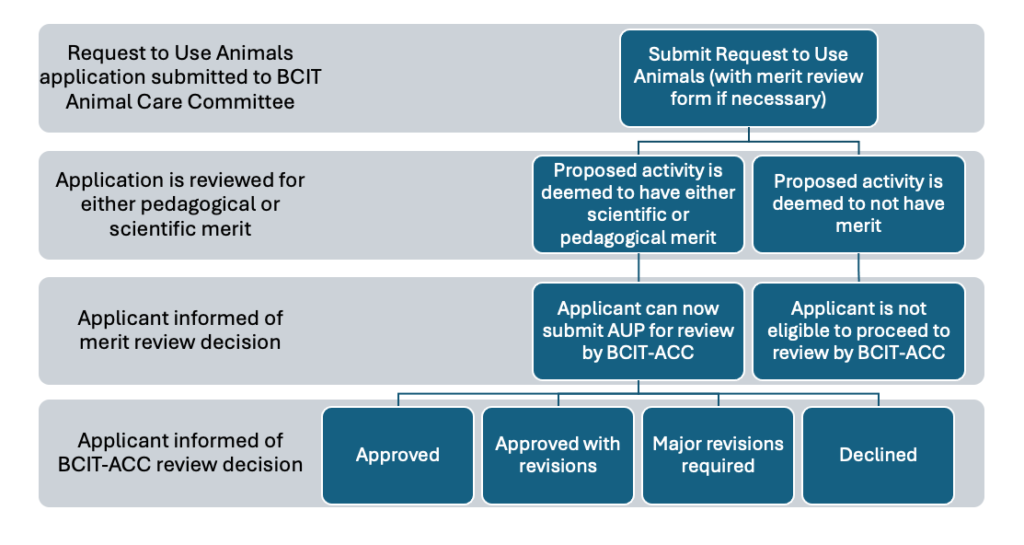
All BCIT faculty and other employees who wish to undertake an activity that involves animals in their research or teaching on campus or in the field must first submit a Request to Use Animals (RUA) to the BCIT-ACC for review and approval.
Animal user training
All animal users must complete theoretical and practical training and demonstrate competency prior to any interaction with animals. Animal users are required to complete theoretical learning about the principals of humane experimental science and ethical issues associated with the use of those animals, including the Three Rs. Additional training may be required depending on the nature of the activity proposed.
Guidelines and policies
Please visit the CCAC website for a full list of their guidelines and policies.
The BCIT-ACC establishes and oversees policies specific to the Animal Care and Use program that are required to ensure the ethical use and treatment of animals in research and teaching at BCIT.
All BCIT-ACC policies can be found in the Animal User training course on the Learning Hub.
Standard operating procedures
The BCIT-ACC maintains several Standard Operating Procedures (SOPs) for a variety of animal-based activities. Applicants who wish to use animals in research or teaching must be familiar with all applicable SOPs and may need to develop an SOP should one not exist for the proposed activity.
If you are considering writing a SOP, please contact the Animal Care Committee to ensure the SOP is not already under development. Complete and submit the BCIT-ACC standard operating procedure template [DOCX] for consideration at any one of the Committee’s review meetings.
Forms and resources
All forms associated with the Animal Care and Use program can be found on the Learning Hub in the Animal User training course. Contact the Animal Care Coordinator if you cannot find the form you need.
Resources
- Canadian Council on Animal Care
- Canadian Association for Laboratory Animal Medicine
- Canadian Federation of SPCAs and Humane Societies
- Orphaned Wildlife Rehabilitation Society
- Scientists Center for Animal Welfare
- National Center for the Replacement, Refinement and Reduction of Animals in Research
- Wildlife Rescue Association
Reporting concerns
Any BCIT member interacting with animals is responsible for ensuring they are complying with Policy 6505 – Animal Care Policy [PDF] and adhering to an approved animal care protocol, if required.
Anyone with direct knowledge or reasonable suspicion of any animal welfare concern, incident, mistreatment of animals, or violations of animal care polices associated with research or teaching at BCIT can report their concerns to the BCIT-ACC Chair, Animal Care Coordinator, consulting veterinarian, or member of the BCIT-ACC.
Reports can be made orally or in writing, openly, confidentially, or anonymously and should include specific details such as event, time, location, and people involved. If a report is confidential, the anonymity of the individual providing the information will be maintained, to the extent allowable, within the scope of collective agreements and BCIT policies and procedures.
Contact the Animal Care Committee
Need more information about the BCIT Animal Care Committee?
Email the ACC