Overview
Mechatronics and Robotics offers the integration of mechanical and electronic components, or mechatronics, and it is possible to design intelligent, reliable, versatile electromechanical systems such as industrial robots, medical devices, aircraft simulators, automated assembly lines, building control systems, and autonomous vehicles.
About the program
The Mechatronics and Robotics program is a unique, multidisciplinary combination of courses that blends knowledge in electronics, mechanics, and computer programming to provide you with both the theory and practical skills you need to design and maintain mechatronic systems. We are proud of the Mechatronics program, and believe that its strengths are built on:
Great Faculty – Our faculty are dedicated to teaching. Many have extensive engineering, science, and industrial experience.
Excellent Labs – Hands-on experience with up-to-date industrial equipment helps you to understand the concepts that you learn in lectures and gives you job-ready, practical skills. Check out our labs on the Lab Tour page.
Fantastic Career Choices – We are proud of our graduates and the many interesting jobs that they do. The multidisciplinary training and education that you’ll receive prepares you for a leadership role in the design and creation of innovative mechatronics products for a variety of applications. After graduation, you might be designing and building automated equipment for the movie industry, medical devices, production equipment, or submarines.
Degree Completion – After two years of study, you can have a great career as a technologist. If you want to earn an engineering degree, you can get advanced placement into engineering programs at BCIT, University of Victoria (through an engineering bridge program, offered by Camosun College), or other local universities. It’s your choice – you’ll make a fantastic technologist or engineer because of your practical training from BCIT!
Who it’s for
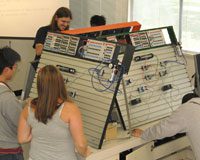
The program us for those interested in keeping up with the speed the world is quickly moving towards a future where many mechanical products contain computers and electronics for monitoring or control are required. This integration of mechanical and electronic components, or mechatronics, makes it possible to design intelligent, reliable, versatile electromechanical systems such as industrial robots, medical devices, aircraft simulators, automated assembly lines, building control systems, and autonomous vehicles. Skills in Mechatronics will be in high demand for many years to come.
Entrance Requirements
Find out more about getting started in the program!
If the Mechatronics program interests you, review the entrance requirements. If you have questions regarding the entrance requirements and equivalents, please contact Program Advising. For more information on the application process, visit Admission & Registration.
If you qualify, you may want to attend an information session or spend-a-day exploring the program. You’ll meet students and instructors, and get a hands-on feel for what the program is about.
Scheduled intakes
September each year.
Application processing
Applications are accepted:
- October 1st* to February 15th*
- February 15th* to April 15th*
*or next business day
This program has multiple application deadlines and may fill after each deadline date.
We recommend that you apply early. All supporting documents must be submitted by the application deadline.
Entrance requirements
Competitive Entry
Preference will be given to applicants with:
- Academic grades above the minimum
- Requirements completed within the last five years
Requirements
- English language proficiency: Category 2 – English Studies 12 (67%) or equivalent
- Math: one of the following:
- Pre-Calculus 12 (73%) or
- Other acceptable BC and Yukon courses
- Physics 11 (73%) or equivalent
- Complete the Self-assessment [PDF], and submit it with your online application.
Department Assessment
All applications will be reviewed by the program area at the application deadline. Admission is competitive and will be offered to the most qualified applicants.
International applicants
This program is available to international applicants.
Study permit: A valid BCIT study permit is required prior to starting the program.
Post-graduation Work Permit (PGWP) eligibility: This program does not meet the eligible field of study requirement (CIP) and is therefore not eligible for students to apply for a PGWP.
(CIPC: 15.0407)
Apply to program
To submit your application:
- Include proof of meeting all entrance requirements.
- Convert all transcripts and supporting documents to PDF files.
- Have a credit card ready to pay the application fee.
Apply Now
Technology entry
The Technology Entry (TE) program is a full-time, day school program which provides academic upgrading to students wishing to enroll in Computing, Engineering, Electronic, and Health Sciences programs at BCIT.
The TE program provides courses in chemistry, communication, mathematics, and physics that meet program prerequisites for selected programs at BCIT. The TE program also includes an introductory course in computer applications and a learning skills course. The program is supportive to those who require English-language training.
myCommunication
Within two business days of submitting your completed application, BCIT will send a message to your personal and myBCIT email addresses. All correspondence regarding your application will be posted to your online myCommunication account at my.bcit.ca. We will send you an email when a new message is posted. It is important to watch for these emails or regularly check your account online.
You can expect to receive communication concerning the status of your application within four weeks.
Advanced Placement
Conditions
You may be eligible to apply to an advanced level of the program through either re-admission or direct entry. Please note that applications are considered based on:
- Complete applications: you must show proof that you have completed (or are registered in) all requirements to be considered.
- Competitive entry: if the number of applicants exceeds available seats, BCIT will accept those deemed to have the best opportunity for success.
- Seat availability: confirmation may not be available until approximately one week before the term begins.
Re-admission
You can apply for re-admission if you:
- were previously admitted to this program and completed part of it at BCIT and
- want to re-enter the program at an advanced level.
Submit the Technology Re-admission Form [PDF] with your application.
Applications are accepted throughout the year.
Ready to submit your application? Apply now.
Direct entry
You can apply for direct entry if you:
- are a new applicant to this program but already completed an equivalent part of it at BCIT or elsewhere and
- want to apply to an advanced level.
BCIT accepts complete applications from:
- February 1st* to October 31st* for level 2 (January start)
- October 1st* to March 31st* for level 3 (September start)
*or next business day
Submit the following with your online application:
- Proof of meeting all general entrance requirements
- Course-by-Course Self-Assessment Form [PDF] showing that you have completed (or are registered in) all courses in the preceding level(s) (or equivalents*)
- Official transcripts and course outlines for all previous education
Applicants who completed post-secondary studies outside of Canada, United States, United Kingdom, Australia or New Zealand will require a comprehensive evaluation of their credentials by the (ICES). Credential evaluation reports from other Canadian services may be considered. These reports must include course-by-course evaluations and GPA calculations. - Resume, outlining previous education and work experience
**Details provided for equivalent courses must outline course descriptions, learning outcomes, and topics covered. Generally, to qualify for credit, the equivalent course(s) must have been completed within five years with a minimum of 65%, and have 80% or more commonality in the topics covered at a level that is comparable or higher. If relevant education was completed more than five years prior, substantial related work experience is required.
Ready to submit your application? Apply now.
Direct entry FAQs
- When should I apply?
- What if I don’t receive credit for all courses in the preceding term?
- Can I appeal the assessment of equivalency?
- What will happen if I cannot complete all required courses before the term starts?
- When will I be accepted?
- What do I do if I have already completed a level 2 or 3 course?
- When will I get my timetable?
- When can I buy my books?
It is recommended that you apply when you have met all of the entrance requirements. If you are currently registered in a course(s), please indicate this on the self-assessment form.
The program may suggest BCIT flexible learning (part-time studies) courses that need to be completed prior to term start. In some circumstances, the program may identify courses that can be taken concurrently. Most students are required to make up one or more courses.
You may appeal in writing. Be prepared to supply addition information or clarification to your original submission. You have 10 days to accept or appeal (in writing) the ‘Second Assessment’ that you receive by email.
All courses must be completed prior to term start unless the program has identified a course that can be taken concurrently or that can be deferred until a later term.
Once your application has been assessed and has been approved for direct entry, a seat must become available in the program you have selected. The Admissions department must wait until the current students obtain their final grades in either December, May, or August to determine how many seats will become available for direct entry applicants.
If you have already completed a course either at another institution or through part-time studies at BCIT, you must apply for course credit/exemption as soon as you have been accepted to the program. You should attend classes until you receive formal written notice that you have been granted course credit. Please note that this will not reduce your tuition fees.
Print your timetable one day prior to class start by logging into my.bcit.ca and going to Student Self-Service. You must be registered in your courses in order to access this feature.
It is recommended that you wait until the first week of classes before buying textbooks. Your instructors will tell you which books to buy.
To register for a Flexible Learning (Part-time Studies) course, visit Register for Flexible Learning courses or contact Student Information and Enrolment Services.
Still have questions? Review the Admissions FAQ or contact Program Advising.
Costs & Supplies
Find out how much you will need to complete your diploma in Mechatronics and Robotics!
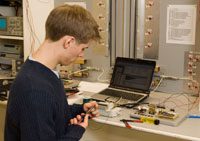
The information below will help you determine the cost of taking the program and assist you in developing a budget for your two years of study. If you have concerns about being able to afford the program, please visit Financial Aid to learn how you may benefit from financial assistance.
Tuition fees
Use our tuition estimator to find tuition and fees for this program.
For more information on full-time tuition fees, visit Full-Time Studies Tuition & Fees.
Books & supplies
Level 1: $600; Level 2: $500; Level 3: $200; Level 4: $0
(general estimated cost, and subject to change)
Financial assistance
Financial assistance may be available for this program. For more information, please contact Student Financial Aid and Awards.
Courses
Explore the courses and classes you will be taking!
The Mechatronics program contains a unique blend of electronics, mechanical, and computing courses. In the first year of the program, emphasis is put on learning the fundamentals in topics such as electronics, math, and physics. Additional topics include 3D computer-aided design, machine shop practice, and programming.
In the second year of the program, you apply the fundamentals to higher-level problems and applications in mechatronics and robotics, culminating in a final project that encompasses many topics that you have learned. Check out some of the projects on our Projects page.
Mechatronics term structure
Each year of the program is divided into two terms – the first term runs from September to December (15 weeks) and the second term runs from January to the end of May (20 weeks) with a one week break in the middle.
Program matrix
| Level 1 (September - December, 15 weeks) | Credits | ||
|---|---|---|---|
| COMM 1164 | Technical Writing 1 for Robotics | 3.0 | |
| ELEX 1205 | DC Circuit Analysis for Robotics | 6.0 | |
| ELEX 1215 | Digital Techniques 1 for Robotics | 6.0 | |
| MATH 1342 | Technical Math for Robotics | 6.0 | |
| MECH 1104 | Computer Aided Design | 4.0 | |
| PHYS 1164 | Physics for Robotics 1 | 5.0 | |
| Level 2 (January - May, 20 weeks) | Credits | ||
| ELEX 2205 | AC Circuits for Robotics | 6.5 | |
| ELEX 2220 | Digital and Electronic Circuits | 8.0 | |
| MATH 2342 | Calculus for Robotics | 8.0 | |
| MECH 1210 | Manufacturing Processes | 5.5 | |
| PHYS 2164 | Applied Physics 2 for Robotics | 6.5 | |
| ROBT 1270 | C Programming | 6.5 | |
| Level 3 (September - December, 15 weeks) | Credits | ||
| ELEX 3321 | Electronics Circuits 2 (Robotics) | 6.0 | |
| MATH 3342 | Transform Calculus and Statistics (Mechatronics & Robotics) | 4.0 | |
| MECH 3356 | Fluid Power | 4.0 | |
| ROBT 3341 | Robot Applications | 6.0 | |
| ROBT 3351 | Automation Equipment | 5.0 | |
| ROBT 3356 | Controller Systems | 6.0 | |
| Level 4 (January - May, 20 weeks) | Credits | ||
| COMM 2464 | Technical Writing 2 for Robotics | 4.0 | |
| ELEX 4336 | Feedback Systems | 8.0 | |
| MECH 0460 | Ethics for Technologists | ||
| OPMT 1184 | Industrial Engineering | 5.5 | |
| ROBT 4451 | Sensor Interfacing | 8.0 | |
| ROBT 4456 | PLC Applications | 4.0 | |
| ROBT 4491 | Mechatronics Project | 6.5 | |
| Total Credits: | 138.0 | ||
The program is in a process of continuous improvement, thus the actual courses may vary from those shown.
Transfer credit
Do you have credits from another BC/Yukon post-secondary school? Do you want to know if they transfer to courses here at BCIT? Check out BCIT's Transfer Equivalency Database to find out.
Program Details
Learn more about the Mechatronics and Robotics Program!
The program information below provides a synopsis of the Mechatronics and Robotics program. You will find out how graduates become accredited technologists, and how your education and training provide a stepping stone to an engineering degree.
A typical week
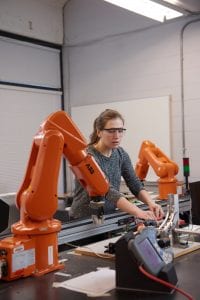
You will spend approximately 30 hours in labs and lectures each week. Classes are scheduled Monday to Friday between 8:30 am – 5:30 pm. You will typically spend an additional 30 hours each week preparing, completing assignments, and studying.
Overall, approximately 50% of your time is spent in lectures, and 50% in labs, giving you a great opportunity to understand the theory and principles while learning practical skills.
Our labs have the latest software and equipment and you will work at your own workstation in many of the labs. Check out our labs on the Lab Tour page.
Small class sizes help you learn
The Mechatronics program accepts 2 sets of students each year with 18 students per set. Both sets are combined for lectures, but separated for labs and tutorials, giving you better access to equipment and assistance in the labs. Small classes encourage an atmosphere of camaraderie, healthy competition, and teamwork, and allow instructors to provide plenty of individual attention to students.
Program length
Two years, full-time, beginning in September each year.
Safety requirements
Your safety is our priority. Students will be required to use a variety of machinery and abide by safety requirements including wearing appropriate personal protective equipment (PPE) such as safety footwear, safety eye and face protection, respiratory protection, protective clothing, and other protective equipment as required. To protect from entanglement, students will have to remove jewelry such as rings, bracelets, necklaces, and watches and secure loose clothing and hair. Details will be covered in the program.Accreditation
Students may apply for student membership with the Applied Science Technologists and Technicians of British Columbia (ASTTBC). Graduates may apply to ASTTBC for registration as an Applied Science Technologist (AScT).
Program delivery
In person: This program is delivered on campus.
Program location
Burnaby Campus
3700 Willingdon Avenue
Burnaby, BC
Graduating & Jobs
Explore the exceptional career opportunities in Mechatronics and Robotics!
“We hired our first BCIT Mechatronics graduate in 2008. We were so pleased with his capabilities that we have since hired two more.”
Darin Elliott, P.Eng.
Manager – Electrical Integration
TRAXX Automation Ltd.
What’s in it for you?
A rewarding career as a technologist
Qualified technologists are well paid and in high demand. A BCIT diploma opens the door to an exciting career as a technical expert who performs a variety of tasks, and who helps others by solving a wide range of technical problems.
Technologists are respected as hard-working, creative, and knowledgeable people.
An edge in the job market
A BCIT diploma shows potential employers that you are accomplished, focused, and serious about your chosen career path. BCIT programs and courses provide both theoretical knowledge and hands-on practical skills to help you be job-ready. Graduates say that BCIT was extremely helpful in preparing them for employment.
A broad range of employment possibilities
The potential job market for Mechatronics and Robotics technologists is great. You could either start your own business or work for a small or large company. Graduates can work in research and development, technical sales, project management, planning, technical writing, and many other fields in addition to the traditional technology areas.
Some of the many employers of BCIT’s Mechatronics and Robotics graduates include:
- enCompass Solutions Group
- Delta Controls
- Triumf
- UniFiller
- Cytiva
- Andritz Automation
- Zaber Technologies
Check out more companies that have hired our grads on our employment page.
Great credentials – a diploma or a degree
After you earn your diploma, you can work as a technologist. After two years of relevant work experience you can apply for accreditation as an Applied Science Technologist (AScT). You may also choose to pursue a bachelor’s degree in engineering, with your diploma giving you a head start.
Continue your education
Graduates of the diploma program have several options for completing a degree:
- BCIT Bachelor of Electrical Engineering degree
- BCIT Bachelor of Technology degree in Electronics (can pursue PEng Designation)
- The Engineering Bridge program at Camosun College enables students to complete their engineering degrees at University of Victoria.
- Lakehead University offers engineering degree completion opportunities for graduate engineering technologists.
Graduate employment outcomes
The BCIT student outcomes report presents summary findings from the annual survey of former students administered by BC Stats one to two years after graduation. These reports combine the last three years of available results for the 2023-2025 BCIT Outcomes Surveys of 2022-2024 graduates and for Degree 2021-2023 graduates. The reports are organized into three-page summaries containing information on graduates’ labour market experiences and opinions regarding their education. More detailed information can be accessed at the BC Student Outcomes website.
To view these results, you may need to have the Adobe Acrobat Reader installed in your Web browser.
Faculty, Advisors & Staff
You have a great team supporting your learning!
The instructors and staff of the Mechatronics and Robotics program are dedicated professionals with a range of experience in electrical, mechanical, engineering, and science. All instructors, whether teaching foundation courses such as math, or technology-specific courses such as robot applications, are dedicated to helping you learn the theory and practical aspects of Mechatronics.
Faculty

Greg Scutt, BSc, MA
Program Head, Mechatronics and Robotics
Tel: 604-432-8350
Email: gscutt@bcit.ca

Isaiah Regacho, BEng
Faculty
Tel: 604-432-8876
Email: iregacho@bcit.ca
Assistant instructors

Autumn Friesen, BEng
Assistant Instructor
Tel: 604-432-8925
Email: andrew_friesen@bcit.ca
Technical staff

Christopher Townsend, DipIT
Technician
Tel: 604-451-6724
Email: ctownsend@bcit.ca
Staff

Jeanie Chan, P.Eng, MASc, BEMP
Associate Dean
Tel: 604-432-8280
Email: Jeanie_Chan@bcit.ca

Courtney Neish
Administrative Assistant
Tel: 604-432-8274
Email: Courtney_Neish@bcit.ca

Melissa Hart
Program Assistant
Tel: 604-451-6868
Email: Melissa_Hart@bcit.ca
Subscribe
Sign up to receive updates, invitations to events, and information about BCIT and your program.
We promise not to spam you, we won’t share your personal information, and you can unsubscribe at any time.
Programs and courses are subject to change without notice.