Overview
The CNC (Computer Numerical Control) Machinist Technician program is a two-year cooperative education training in manual and CNC machining. Today’s manufacturing uses innovative technologies including sophisticated Computer Numerical Control (CNC), Computer Aided Manufacturing (CAM) software and specialty materials to develop and build products.
About the program
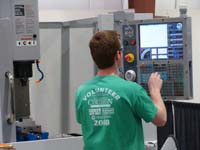
Product Development
BCIT CNC Grad 2009
VMAC
Vehicle Mounted Air Compressors
BCIT is the largest provider of CNC machinist education and training in BC. The program uses the latest technologies in education to combine theory and practical lessons in a work-like environment. The strengths of the BCIT machinist programs include:
Great faculty – Our faculty are dedicated to teaching. Many have extensive manufacturing, engineering, and industrial experience.
Machine facilities – Learn through theory and hands-on practical assignments in our 30,000-square-foot shop. Our state-of-the-art industrial equipment, computer numerical control machines, and computer aided manufacturing software will help you understand the concepts learned in lectures and give you job-ready, practical skills.
Fascinating career paths – The opportunities as a CNC machinist technician can be very challenging and lucrative.
Co-operative education – A 33-week co-op work term supplements in-school learning.
Who it’s for
Machining might be for you if you like making things with precision with or without the aid of a computer, if you consider yourself to be a bit of a techie, or if you take pride in seeing high-quality manufactured products. If that sounds like you, consider a career as a machinist!
Training is designed for high-school graduates and tradespersons who wish to upgrade their skills in the operation, IG coding, conventional and CAD/CAM programming of CNC equipment. Graduates receive a Diploma in Trades Training.
What grads can do
After successfully completing the CNC Machinist Technician program, graduates have the option to complete an apprenticeship in the machinist trade. Graduates receive a credit of 500 work-based training hours, as well as term 2 co-op work hours. Additionally, grads will receive credit for ITA Machinist Apprenticeship Levels 1 – 3 technical training. After successful completion of all apprenticeship requirements, graduates will receive the BC Certificate of Apprenticeship, the BC Certificate of Qualification, and the Interprovincial Standard Endorsement, also known as the Red Seal.
Today’s manufacturing utilizes innovative technologies, including sophisticated Computer Numerical Control (CNC), Computer Aided Manufacturing (CAM) software and specialty materials to develop and build the products of tomorrow. CNC Machinist technicians design, manufacture and repair components, parts and tools from a variety of metals and other engineered materials using traditional and state-of-the-art machines. Many machinists of today can be found transferring complex mechanical engineering drawings from the computer screen to computerized machinery.
Our grads find jobs in the following industries:
- Aerospace industry
- Automobile/motorcycle industry
- Medical research industry
- Innovative technologies industry
- Research and development industry
- Forestry and mining industry
- Manufacturing machine parts industry
Graduates are prepared to complete an apprenticeship as a Machinist.
Entrance Requirements
Find out more about getting started in the program!

If the CNC Machinist program interests you, review the entrance requirements. If you qualify, you may want to attend an information session or become a student for a day.
Spend-A-Day with us
Want to learn more about our program before you apply? Come Spend-A-Day with us. You’ll meet students and instructors, and get a hands-on feel for what the program is about.
If you have questions regarding the entrance requirements or the application process, visit Admission & Registration or if you want to discuss the program in more detail, contact the Department Head, Stefano Pettenon, or call 604-432-8214.
Application processing
Applications are accepted throughout the year.
Entrance requirements
Applicants must meet all entrance requirements and will be accepted on a first qualified basis as long as space remains. When available intakes are full, qualified applicants are wait-listed.
Applicants must meet all entrance requirements prior to applying to this program. If you are uncertain or don’t meet the requirements we strongly recommend you complete any applicable Trades Entry Assessments before applying.
- English language proficiency: one of the following:
- Category 3 – English Studies 12 (50%) or equivalent or
- BCIT English Trades Entry Assessment
- Math: one of the following:
- Pre-Calculus 11 (50%) or
- Foundations of Math 11 (60%) or
- Workplace Math 11 (67%) or
- Other acceptable BC and Yukon courses or
- BCIT Math Trades Entry Assessment
Recommended for success
- Applicants should have:
- Good command of oral and written English
- Sufficient physical strength and stamina to meet the demands of the work, good hearing, good eyesight, normal colour vision, manual dexterity and hand/eye coordination
- Good theoretical and practical mathematical skills and mechanical aptitude
- Potential students with medical or physical difficulties should contact Accessibility Services to arrange an interview (telephone interview if out of town) with the institute's rehabilitation specialist at 604-451-6963.
Trades Discovery
The Trades Discovery General and Trades Discovery for Women are full-time programs designed to prepare participants to successfully enter and complete a Trades Training program.
International applicants
This program is not available to international students. View available programs.
Apply to program
To submit your application:
- Include proof of meeting all entrance requirements.
- Convert all transcripts and supporting documents to PDF files.
- Have a credit card ready to pay the application fee.
Apply Now
Scheduled Intakes
January and September
*Scheduled intakes are subject to change
myCommunication
Within two business days of submitting your completed application, BCIT will send a message to your personal and myBCIT email addresses. All correspondence regarding your application will be posted to your online myCommunication account at my.bcit.ca. We will send you an email when a new message is posted. It is important to watch for these emails or regularly check your account online.
You can expect to receive communication concerning the status of your application within four weeks.
Costs & Supplies
Find out how much you will need to complete your Diploma in CNC Machinist Technician!
The information below will help you determine the cost of taking the program, and will assist you in developing a budget for your two years of study. If you have concerns about being able to afford the program, please visit Financial Aid to learn how you may benefit from financial assistance.
Tuition fees
Use our tuition estimator to find tuition and fees for this program.
For more information on full-time tuition fees, visit Full-Time Studies Tuition & Fees.
Books & supplies
Level 1: $1,276; Level 3: $199
(general estimated cost, and subject to change)
Students are required to supply their own safety glasses, CSA approved high top leather steel toe boots and coveralls. Coveralls must be cotton or fire retardant. Special retail supplier pricing is available for students. Please check the uniform authorization voucher [PDF] for details.
Financial assistance
Financial assistance may be available for this program. For more information, please contact Student Financial Aid and Awards.
Courses
Explore the courses and classes you will be taking!

The CNC machinist technician program contains a blend of classroom lectures and practical shop sessions using the latest technology. In the first term of the program, emphasis is put on learning the fundamentals of machining in topics such as engineering drawing, trade math, metallurgy, precision measuring instruments, lathe, mill, and grinder machines. In the second Co-op Term, you will practice your knowledge in a real world manufacturer. The third term, you will learn state of the art CNC machine operation and CAD/CAM programming.
CNC Machinist Technician term structure
This two-year program has two start dates a year. Each intake is divided into three terms 33 weeks long, with a format of approximately 50% theory and 50% practical hands-on. The fall intake classes run in the morning, and the winter intake classes run in the afternoon.
Fall intake: 0700-1330, Monday through Friday
Term 1 – Manual Machining (September to April)
Term 2 – Co-op Work (May to December)
Term 3 – CNC Machining (January to August)
Winter intake: 1230-1900, Monday through Friday
Term 1 – Manual Machining (January to August)
Term 2 – Co-op Work (August to April)
Term 3 – CNC Machining (April to December)
Class hours
0700–1330 or 1230–1900, Monday through Friday
Program matrix
| Level 1 (33 weeks) | Credits | ||
|---|---|---|---|
| MACH 1500 | Safe Work Practices | 4.0 | |
| MACH 1502 | Mathematics for Machinists | 3.0 | |
| MACH 1504 | Interpretation of Drawings | 3.0 | |
| MACH 1506 | Layout and Measuring | 6.0 | |
| MACH 1508 | Support Machines | 6.0 | |
| MACH 1510 | Lathe Operations | 10.0 | |
| MACH 1512 | Mill Operations | 6.0 | |
| MACH 1514 | Advanced Lathe Operations | 2.0 | |
| MACH 1516 | Advanced Mill Operations | 4.0 | |
| MACH 1518 | Materials and Metallurgy | 2.0 | |
| MACH 1520 | Service and Maintenance | 3.0 | |
| MACH 1522 | Grinding Operations | 3.0 | |
| MACH 1524 | Employment Preparation | 0.5 | |
| MACH 1526 | Oxyacetylene Cut and Weld | 2.0 | |
| MACH 1528 | CNC Concepts | 3.0 | |
| MACH 1530 | Assembly Project | 8.5 | |
| Level 2 (33 weeks) | Credits | ||
| MACH 1990 | Co-op | 33.0 | |
| Level 3 (33 weeks) | Credits | ||
| CNCS 2201 | Fundamentals of Computer Numerical Control | 4.0 | |
| CNCS 2202 | Programming Fundamentals | 4.0 | |
| CNCS 2203 | Programming Turning Centres | 4.0 | |
| CNCS 2204 | Programming Machine Centres | 4.0 | |
| CNCS 2205 | Setup and Operate Turning Centre | 18.0 | |
| CNCS 2206 | Setup and Operate Machine Centres | 18.0 | |
| CNCS 2207 | Computed Aided Design | 4.0 | |
| CNCS 2208 | Computer Aided Manufacture | 8.0 | |
| CNCS 2209 | Coordinate Measuring Machine | 2.0 | |
| Total Credits: | 165.0 | ||
Transfer credit
Do you have credits from another BC/Yukon post-secondary school? Do you want to know if they transfer to courses here at BCIT? Check out BCIT's Transfer Equivalency Database to find out.
Program Details
CNC machinist technician machinists manufacture components, parts and design tools and fixtures from a variety of metals and other engineered materials using traditional and state of the art machines.
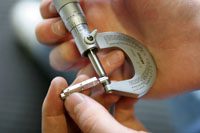
During program study, theory covered includes:
- Metallurgy precision measuring tools and instruments
- Interpretation of engineered drawings
- Hand tools and power tools
- Machine operation including lathes, milling machines, and grinders
- Computer numerical control (CNC) machines
- Computer aided design (CAD)
- Computer aided manufacturing (CAM)
- Co-ordinate measuring machine (CMM)
Program length
99 weeks, full-time
Level 1 - 33 weeks (Manual Machining)
Level 2 - 33 weeks (Co-op Work Term)
Level 3 - 33 weeks (CNC Machinist Specialization)
Grading
Course passing grade is 70% for each component within a course with a minimum passing grade of 70% for each course. In order to successfully complete the program each level requires a minimum grade point average (GPA) of 70%. There is no minimum pass mark required for the Apprenticeship exams.
Program delivery
In person: This program is delivered on campus.
Program location
Burnaby Campus
3700 Willingdon Avenue
Burnaby, BC
SkilledTradesBC
BCIT transfers the student's name, contact information, Personal Education Number (PEN), and the name and date of the completed Foundation program to SkilledTradesBC. This information is used for the purposes of tracking successful completions in order to grant credit towards apprenticeship where applicable, and communicating with trainees to promote continuation in an apprenticeship program.Co-operative education
A cooperative education (co-op) program formally integrates students' academic studies with relevant, paid work experience. Co-op coordinators assist students in finding meaningful work placements and monitor the student's progress on the job. During periods of the business cycle, work experience placements may be difficult to obtain. Ultimately, it is the student's responsibility to secure a work experience placement.
For more information, please visit BCIT's Centre for Workplace Education (Co-op) located in Building NW5, Room 101 at the Burnaby campus.
Marion Gasbarro
Co-op Coordinator
Tel: 778-928-2458
Email: marion_gasbarro@bcit.ca
Graduating & Jobs
A rewarding career as a CNC machinist technician
A career in the machinist trade can lead to a variety of interesting work in a wide scope of manufacturing industries. Some of the areas of specialization may be CNC programming or Quality Control.
After completing CNC Machinist Technician programs, students can follow the path of an apprentice and earn while they learn.
Graduates from this program can expect credit for the first three levels of technical training for the machinist apprenticeship.
An array of job opportunities as a:
CNC Machinist or Machinist
- Interpreting engineered drawings and manufacturing a variety of complex parts using a variety of machinist equipment
- Set up and run computerized lathes, mills and grinders to manufacture specific parts
CNC Programmer
- applying all the machining skills to efficiently set up and programme automated machinery
Quality Control inspect and verify production of parts to ensure they are within tolerances for size specifications
An edge in the job market
A BCIT trades diploma shows potential employers that you are accomplished, focused, and serious about your chosen career path. BCIT programs and courses provide both theoretical knowledge and hands-on practical skills to help you be job-ready. Graduates say that BCIT was incredibly instrumental in preparing them for employment.
A broad range of employment possibilities
The potential job market for CNC Machine Technician is great. You could either start your own business or work for a small or large company. Graduates can work in research and development, manufacturing, technical sales, quality control, and CNC programming.
Some of the many employers of BCIT’s CNC machinist technician graduates include:
Graduate employment outcomes
The BCIT student outcomes report presents summary findings from the annual survey of former students administered by BC Stats one to two years after graduation. These reports combine the last three years of available results for the 2022-2024 BCIT Outcomes Surveys of 2021-2023 graduates and for Degree 2020-2022 graduates. The reports are organized into three-page summaries containing information on graduates’ labour market experiences and opinions regarding their education. More detailed information can be accessed at the BC Student Outcomes website.
To view these results, you may need to have the Adobe Acrobat Reader installed in your Web browser.
Faculty, Advisors & Staff
All of our instructors are qualified experienced Machinists or Tool and Die Makers/Mold Makers. Their passion for the trade is evident in their pursuit for the highest product standard, and they mentor their students to achieve the same success.
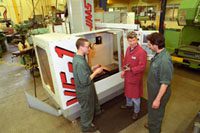
Some of our instructors are BCIT graduates, who have succeeded in industry and now have come back to offer their wisdom and knowledge to the students.
Some of our instructors have bachelor and master degree. If you find the machinist career is not challenging enough, you could continue education at BCIT to study a Bachelor of Manufacturing Technology program to obtain a bachelor degree in manufacturing.
Many of our students have the opportunity to gain a global manufacturing perspective, as some of our instructors have experience working in Europe, Asia, and North America.
Faculty
Stefano Pettenon, RSE
Department Head
Tel: 604-432-8214
Email: spettenon@bcit.ca
Marte Arreola, MEd, RSE
Tel: 604-432-8477
Email: marte_arreola@bcit.ca
Chelsea Barron, RSE
Tel: 604-453-4038
Email: cbarron4@bcit.ca
Ali Daeizadeh, RSE
Tel: 604-453-4028
Email: adaeizadeh@bcit.ca
Michel Gaudet, RSE
Tel: 604-419-3783
Email: michel_gaudet@bcit.ca
Mustafa Sajid, MEd, RSE, Tool and Die ON
Tel: 604-456-8122
Email: mustafa_sajid@bcit.ca
Thomas Sowinski
Tel: 604-453-4027
Email: thomas_sowinski@bcit.ca
Greg Wahl, RSE, Tool and Die IP
Tel: 604-451-7064
Email: greg_wahl@bcit.ca
Steven Wealick
Tel: 604-453-4029
Email: steven_wealick@bcit.ca
Technical Staff
Miro Gataric
Tool Room Attendant
Tel: 604-451-6736
Email: miro_gataric@bcit.ca
Daniel Szakaly
Tool Room Attendant
Tel: 778-331-1794
Email: dszakaly@bcit.ca
Bradley Taylor
Maintenance Mechanic
Tel: 604-432-8935
Email: bradley_taylor@bcit.ca
Staff
Jeanie Chan, P.Eng, BEMP, MASc
Interim Associate Dean, Mechanical Engineering
Tel: 604-432-8280
Email: jeanie_chan@bcit.ca
Courtney Neish
Administrative Assistant
Tel: 604-432-8274
Email: Courtney_Neish@bcit.ca
Melissa Hart
Program Assistant
Tel: 604-451-6868
Email: Melissa_Hart@bcit.ca
Advisory committee
Claudio Bolognese
Manager, Machining Engineering Group, Seastar Solutions
Ed Bendfeld
President, Canam Tool & Engineering Inc.
Indy Dhaliwal
Shop Foreman, Johnson Industries Ltd.
Al Dickens
Operations Manager, Murray Latta Progressive Machine Inc.
Surinderpal Ghotra
President & CEO, Cimtech Manufacturing Inc.
Contact Us
Courtney Neish
Administrative Assistant
Tel: 604-432-8274
Email: Courtney_Neish@bcit.ca
Melissa Hart
Program Assistant
Tel: 604-451-6868
Email: Melissa_Hart@bcit.ca
Questions or comments?
Subscribe
Sign up to receive updates, invitations to events, and information about BCIT and your program.
We promise not to spam you, we won’t share your personal information, and you can unsubscribe at any time.
Programs and courses are subject to change without notice.