Overview
Bachelor of Technology in Technology Management program
Looking to take your technical career to the next level? BCIT’s Bachelor of Technology in Technology Management (TMGT) program is designed for working professionals who want to develop advanced management and leadership skills without stepping away from their technical field. Through flexible learning options, this program empowers you to customize your education to fit your career goals and schedule while continuing to grow as a technical specialist.
About the program
The Bachelor of Technology in Technology Management is a unique program that blends technical expertise with business and management skills, preparing you for leadership roles in a variety of technical industries. Whether you’re in IT, engineering, manufacturing, or another technical field, you can tailor the program to align with your specific area of interest.
One of the key features of this program is its flexible learning model. Courses are delivered both online and in-person, allowing you to choose what works best for your busy schedule. As a working professional, you’ll find the program’s modular design ideal for balancing your career, education, and personal life.
Throughout the program, you’ll be taught by senior technology managers from the industry, giving you the benefit of their real-world experience. You’ll gain valuable insights not only from your instructors but also from your peers, as your classmates come from diverse technical backgrounds, each facing unique challenges in their sectors. This networking opportunity is invaluable as it exposes you to different perspectives and solutions within various industries.
Who should apply
This program is a great fit for technical professionals passionate about growing into leadership roles and guiding teams in their industry. People who thrive in this program are typically those who enjoy solving complex problems, streamlining processes, and envisioning ways to make their organizations more effective. They’re often motivated by the idea of making a larger impact in their field and are interested in building the skills to lead projects, manage people, and drive innovation.
If you’re energized by challenges, fascinated by the intersection of technology and business, and excited about applying strategic thinking to technical environments, this program could be a perfect next step. It’s designed for those who seek flexibility and want to enhance their career potential without stepping away from their current roles, empowering them to continue doing what they love while expanding their capabilities in management and leadership.
What grads can do
Graduates of the Technology Management BTech program are well-positioned for leadership roles across various technical industries. By combining advanced technical knowledge with essential management skills, you’ll be equipped to step into roles that require both operational expertise and strategic thinking.
BCIT’s TMGT graduates have successfully moved into positions such as:
• IT Service Delivery Director
• Senior Systems Engineer
• Engineering Technologist II
• Project Manager
• Plant Manager
• Senior Software Developer
• Quality Assurance Coordinator
• IT Project Manager
• Technical Program Manager
• Director of Corporate Data & Integrations
The program’s strong industry connections also provide networking opportunities throughout your studies. You’ll engage with professionals and industry leaders during your coursework, offering valuable insights and potential career connections. These interactions, coupled with the program’s focus on career evolution, allow you to build a powerful network that can support your professional growth long after graduation.
If you’re looking to advance your career, lead teams, and tackle complex technical challenges, BCIT’s Bachelor of Technology in Technology Management will give you the tools to succeed. Apply today and take your technical expertise to the next level!
Meet one of our grads

Success story: Sunny Ghataurah, Director of Applied Engineering Solutions and TMGT 2011 graduate.
Sunny is one of the winners selected by Business in Vancouver 2014 ‘Top 40 Under 40’. The award highlights BC’s outstanding professionals who are under 40 and have demonstrated excellence in business and leadership within BC.
Entrance Requirements
Application processing
Applications are accepted throughout the year with intake options available during the following periods:
| Intake | Opening (9:00 am) | Deadline (11:59 pm) |
|---|---|---|
| Winter (January) | February 1st* | Domestic students: January 2nd* International students: November 1st* |
| Spring/Summer (April) | May 1st* | Domestic students: April 1st* International students: February 1st* |
| Fall (September) | October 1st* | Domestic students: September 1st* International students: July 2nd* |
*or next business day
Intakes may fill before the deadline. If you are currently registered in a course or planning to start, submit your application early to secure your spot in the program.
Entrance requirements
This program has a two-step admission process. Applicants must meet all entrance requirements and will be accepted on a first-qualified basis as long as space remains.
Step 1: Pre-entry assessment
Applicants are required to have their work experience reviewed and assessed prior to applying. Please email the program administrator to receive a program information kit which includes detailed information on the program, how to have a pre-assessment of your work experience completed, and how to formally apply online.
An approved pre-entry assessment from the program area must be uploaded to complete your application.
Step 2: Meet the following entrance requirements
- English language proficiency: Category 2 – English Studies 12 (67%) or equivalent
- Work experience: minimum of one year relevant technical work experience.
- Post-secondary: one of the following from a recognized institution:
- Diploma from BCIT (or an equivalent technical credential with a minimum of 110.0 credits) or
- Related degree from a recognized post-secondary institution or
- Alternate Entry Model: designed for career-oriented adults who do not have post-secondary education equivalent to a diploma. Candidates may be considered for special admission (alternate entry) if they have at least five years of relevant technical work experience.
*Post-secondary partners
- Centennial College Diplomas:
- Aerospace Manufacturing Engineering Technician – 3 years co-op
- Aircraft Maintenance and Management – Aviation Technology – 3 year Advanced Diploma
- Architectural Technology – 3 years
- Automation and Robotics – Electrical Mechanical Engineering – 3 years co-op
- Aviation Technician (Aircraft Maintenance or Avionics options)
- Avionics Maintenance and Management – Aviation Technology – 3 year Advanced Diploma
- Biomedical Engineering Technology – 3 years
- Electrical Engineering Technology – 3 years co-op
- Energy Systems Engineering Technology – 3 years co-op
- Environmental Technology – 3 years co-op
- Game – Programming – 3 years coop
- Mechanical Engineering Technology – Design – 3 years
- Mechanical Engineering Technology – Industrial – 3 years
- Networking – Computer Systems Technology – 3 years
- Software Engineering Technology – 3 years co-op
- Software Engineering Technology – AI – 3 years co-op
- Humber College Advanced Diplomas:
- Civil Engineering Technology
- Computer Engineering Technology
- Electrical Engineering Technology – Control Systems
- Electromechanical Engineering Technology
- Electronics Engineering Technology
- Mechanical Engineering Technology
- Sustainable Energy and Building Technology
Applicants who have completed post-secondary studies outside of Canada, the United States, the United Kingdom, Australia or New Zealand may require a comprehensive evaluation of their credentials by the International Credential Evaluation Service (ICES). Credential evaluation reports from other Canadian services may be considered. These reports must include course-by-course evaluations and GPA calculations.
Read more about how to meet BCIT’s entrance requirements
Note: You do not need to be accepted into the degree program to register for Technology Management (TMGT) courses. However, taking TMGT courses does not guarantee your acceptance into the program. If accepted into the program, you may receive credit for the TMGT courses you have taken previously, provided the course content has not changed substantially. It is highly recommended that you complete no more than 6.0 credits of TMGT courses before formally applying to the program. This is to ensure you are able to complete the program and be awarded a credential
International applicants
The in-person delivery option is not available to international applicants.
The online delivery option is available to international applicants who will complete the program from outside Canada and are able to complete the Capstone Graduation project requirement with their work organization.
Study permit: International applicants accepted into this program are not eligible for a study permit.
Post-graduation Work Permit (PGWP) eligibility: While this program currently meets the study program - graduates with a bachelor’s degree criteria to apply for a PGWP, this program is not eligible for a PGWP due to other criteria not being met. There are no field of study requirements (CIP) for graduates with a bachelor’s degree.
Apply to program
To submit your application:
- Include an approved pre-entry assessment form from the Technology Management department.
- Include proof of meeting all entrance requirements.
- Convert all transcripts and supporting documents to PDF files.
- Have a credit card ready to pay the application fee.
Apply Now
Scheduled Intakes
January, April, and September.
myCommunication
Within two business days of submitting your completed application, BCIT will send a message to your personal and myBCIT email addresses. All correspondence regarding your application will be posted to your online myCommunication account at my.bcit.ca. We will send you an email when a new message is posted. It is important to watch for these emails or regularly check your account online.
You can expect to receive communication concerning the status of your application within four weeks.
Courses
Program matrix
Check current availability of courses for this program.
| 1. Management Courses (23.0 credits) | Credits | ||
|---|---|---|---|
Technology Management |
|||
| TMGT 7101 | Engineering, Technology and Management | 1.0 | |
| TMGT 7102 | Project Management/Resource Utilization | 2.0 | |
| TMGT 7103 | Research and Development Management | 1.0 | |
Marketing Management |
|||
| TMGT 7111 | High Technology Marketing Strategies | 1.0 | |
| TMGT 7112 | Marketing Research | 1.0 | |
| TMGT 7113 | Marketing Programs and Plans | 1.0 | |
| TMGT 7114 | Product Planning and Marketing Implementation | 1.0 | |
Financial Management |
|||
| TMGT 7121 | Principles of Finance | 1.0 | |
| TMGT 7122 | Accounting for Technologists | 1.0 | |
| TMGT 7123 | Technology Information Systems | 1.0 | |
| TMGT 7124 | Technology and International Finance | 1.0 | |
Business Development Management |
|||
| TMGT 7133 | Law for Intelligence-based Business | 1.0 | |
| TMGT 7134 | Technology and International Trade and Competition | 1.0 | |
| TMGT 7135 | Strategy, Innovation and Entrepreneurship | 3.0 | |
Human Resource Management |
|||
| TMGT 7142 | Technology Management Communication | 1.0 | |
| TMGT 7143 | Problem Solving and Decision-Making | 1.0 | |
| TMGT 7144 | Human Resource Planning and Control | 1.0 | |
| TMGT 7145 | Leadership in a World of Change | 3.0 | |
| 2. Advanced Technology Courses (15.0 credits required) | Credits | ||
Students of the degree program come from a broad cross-section of technical areas and can select 15.0 credits of courses that best suit their professional goals. These elective courses may be selected from among 7000 and 8000 level courses from other degree programs, such as:
Advanced technology courses are intended to reflect technical domains or sector-specific domains where technology is applied. Courses should not be similar to any of the management courses offered in the Technology Management degree program. Courses from other institutions of higher learning will also be considered, including higher level Transport Canada-endorsed courses. Students must obtain pre-approval from the Technology Management (TMGT) program head for non-TMGT advanced technology courses prior to registering. Students must also receive approval from the program head, or delegate, of a non-TMGT courses. If a prerequisite is required, it must be completed first. Credit for prerequisite courses will not be applied towards advanced technology electives. Note regarding DIGH:
Note regarding MIMG:
Note: BUSA 7250 - Management Skills and Applications is not an acceptable advanced technology course elective. The following are suggested (available) courses that are suitable for a wider audience to augment any technical area of study: |
|||
| EENG 7000 | Introduction to Climate Change, Ecology, and Systems Thinking | 3.0 | |
| TMGT 7151 | Implement Issues in Telecom | 3.0 | |
| TMGT 7152 | Implementation Issues in Data Management | 3.0 | |
| TMGT 7153 | Tactical and Strategic Business Use of the Internet | 3.0 | |
| TMGT 7154 | Trends in New and Emerging Information Technologies | 3.0 | |
| TMGT 7155 | Information Technology Management Issues | 3.0 | |
| TMGT 7156 | IT Risk Management | 3.0 | |
Please contact the Technology Management (TMGT) program head to confirm acceptable electives or alternate courses for the advanced technology electives. |
|||
| 3. Graduation Project (15.0 credits) |
Credits | ||
| Through the Graduation Project the candidates will solve a significant problem or explore innovative ideas for improvement of their employer's organization through a value-added project. This technology transfer is one of the major goals of the program and is intended to support BCIT's mandate as the Center of Advanced Technology training in British Columbia. | |||
| TMGT 8101 | Directed Studies | 3.0 | |
| TMGT 8102 | Applied Research Methods | 3.0 | |
| TMGT 8103 | Technology Assessment | 3.0 | |
| TMGT 8104 | Project | 6.0 | |
| 4. Liberal Studies (12.0 credits required) | Credits | ||
Mandatory Courses: (6.0 credits) |
|||
| LIBS 7001 | Critical Reading and Writing | 3.0 | |
| LIBS 7002 | Applied Ethics | 3.0 | |
Elective Courses: (6.0 credits) Note: BCIT Liberal Studies offers industry specific applied ethics courses, including:
Contact the program head to confirm acceptable electives or alternate courses. |
|||
| Total Credits: | 65.0 | ||
Check current availability of courses for this program.
Transfer credit
Do you have credits from another BC/Yukon post-secondary school? Do you want to know if they transfer to courses here at BCIT? Check out BCIT's Transfer Equivalency Database to find out.
Program Details
Program length
Three to five years, part-time.
Courses are offered through flexible learning (part-time studies) at BCIT. These are delivered as conventional courses, seminars and workshops, and by online. This will allow individuals to maintain full-time employment while working towards completing their degree. The rate of progress through the program will vary. Most individuals will likely take three to five years to complete their studies, but all have up to seven years to complete the program requirements. Candidates are expected to maintain at least a 65% average during the program. Candidates will graduate with distinction in the degree if a grade point average of 80% is maintained.
Grading
Candidates are expected to maintain at least a 65% average during the program. Candidates will graduate with distinction if a grade point average of 80% or higher is maintained.
Program delivery
The program is available in the following delivery modes, allowing students to complete the credential in various ways:
- In person: The program is delivered on campus.
- Online: The program is delivered fully online.
The program offers flexibility to students by allowing them to complete courses in any order, as long as the prerequisites are fulfilled. Students have the option to register for each course individually and can study in any term.
Please check the individual course schedule pages. Some courses are delivered entirely online and others are entirely on campus, allowing students with the flexibility to manage their coursework alongside full-time employment. They can choose between in-person and online courses based on their preferences.
Courses are not held concurrently in each delivery mode every term. All TMGT courses are tentative and subject to change and/or cancellation.
Program location
Burnaby Campus
3700 Willingdon Avenue
Burnaby, BC
Courses are also offered through online learning.
Classroom in-person courses:
- Classroom courses are offered at the BCIT Burnaby Campus.
- In-person sessions involve required attendance with participation and engagement expected throughout the duration of the course.
- Scheduling typically involves weekly weeknight sessions for the course duration.
Instructor-led online courses:
- Participation is an evaluation criteria decided by your instructor (e.g., they may take attendance). Please refer to your TMGT Student Guide, Section 1.0 - Attendance Policy for more information.
- There may be mandatory real-time or asynchronous virtual classroom sessions, online discussions, and/or potential group work.
- You will have mandatory assignment and/or project/presentation due dates. You will be graded and given feedback.
- You may contact your instructor with any questions regarding assignments, course material, etc.
You can take the program entirely through online learning, entirely in classroom format, or as a combination of both.
Program structure
With one unit of credit equivalent to 15 hours of classroom instruction, the distribution of credits between components is as follows:
| Management/Technology Component | ||
| Management Courses | 23.0 | |
| Advanced Technology Courses | 15.0 | |
| Graduation Project | 15.0 | |
| Liberal Studies Component | 12.0 | |
| Total credits: | 65.0 | |
Under Management Courses, there are five areas of study, each composed of three to four courses of one credit each:
- Technology Management
- Financial Management
- Marketing Management
- Business Development Management
- Human Resource Management
The above course titles reflect the general areas related to the topic and each course within these areas is built on the distinctive qualities and issues that are specifically relevant to technology management as a whole.
It is highly recommended that new Technology Management students take TMGT 7101, TMGT 7142 and LIBS 7001 as their first courses, to provide them with a stable foundation.
Advanced Technology
Students may select courses that best suit their career and professional goals. These courses may be selected from among 7000 and 8000 level courses from other BCIT Bachelor of Technology degree programs.
Courses must be advanced technology level courses in a degree program. Courses should not be similar to any of the courses offered in the Technology Management degree program. Courses from other institutions of higher learning will also be considered, including higher level Transport Canada-endorsed courses.
Advanced technology course selections must be approved by the Technology Management program head. Selected courses should constitute a logical and cohesive package that is academically sound and enhances the skills and/or career options of the graduate. Please see the program matrix for information on the approval process.
Transfer credit
If you intend to apply for transfer credits, you must apply to the program, pay an application fee, and be accepted to be assessed for eligibility.
Continue your education
Upon completion, Technology Management graduates may proceed to Simon Fraser University's Master of Technology (MOT) program and have the option to complete the MOT in one year full-time, or two years part-time. SFU now delivers evening courses which will provide greater flexibility to part-time students who wish to continue working while completing the MOT MBA.
TMGT graduates are making valuable SFU-acknowledged contributions to the MOT MBA classes and are encouraged to continue their education and view the MOT MBA as a valid option after completing the TMGT degree.
For further information and admissions requirements for SFU MOT, please contact Simon Fraser University.
Graduating & Jobs
Job opportunities
Graduates of the program can be from a variety of industries and assume leadership roles as supervisors and managers at the junior and mid-management levels. Technologists and trades technicians may also strive for self-employment as independent contractors and consultants or sole proprietors of their own business.
Technologists, technicians and technical specialists in this degree program have their careers grounded in fields such as biomedical engineering, information technology, civil, electronics, mechanical, airport operations, aircraft maintenance, avionics and many others.
Graduate employment outcomes
The BCIT student outcomes report presents summary findings from the annual survey of former students administered by BC Stats one to two years after graduation. These reports combine the last three years of available results for the 2023-2025 BCIT Outcomes Surveys of 2022-2024 graduates and for Degree 2020-2022 graduates. The reports are organized into three-page summaries containing information on graduates’ labour market experiences and opinions regarding their education. More detailed information can be accessed at the BC Student Outcomes website.
To view these results, you may need to have the Adobe Acrobat Reader installed in your Web browser.
Faculty, Advisors & Staff
Terry Suen
Program Head – Bachelor of Technology
School of Transportation
Tel: 604-451-6886
Email: Terry_Suen@bcit.ca
Megan Alford
Program Administrator – Bachelor of Technology
School of Transportation
Email: malford2@bcit.ca
What's New
Congratulations to TMGT Grads of Spring 2025!
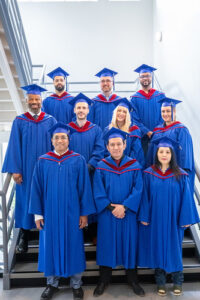
Middle row (left to right) – Reinaldo, David, Megan, Dana
Top/Back row (left to right) – Jay, Richard, Husani
Congratulations to TMGT graduates of 2025, our very best wishes going forward in all that you will continue to achieve:
Israel Acosta-Rangel, Richard Arsenault, Ephraim Bautista, Tyler Bishop, David Buckingham, Zhihong Chen, Bryan Daniel, Gary Gallian, Reinaldo Gonzalez, Akshita Kaur, Jay Khera, Michelle Legge, Garret McDonald, Steve Mathews, David Middleton, Megan Riekki, Dana Sliman, Shallin Wu
Congratulations to TMGT Grads of Spring 2024!
Congratulations to Spring 2024 grads as they join their former TMGT classmates and now fellow graduates from this year’s earlier convocation: Michael Cillis, Stephan de Klein, Jastej Dhillon, Brian Lee, Matthew Sun, and Tonja Teolis.
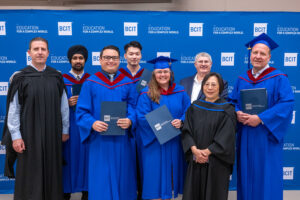
Special shout-out to the 2024 year award recipients; Julie Suo-Anttila, TMGT Achievement Award, and Brett Taylor, School of Transportation’s Dean’s Award for Achievement, Bachelor of Technology. Congratulations to all!
Photo caption: (Front row, left to right: Gerry Egan, Associate Dean, Matthew Sun, Tonja Teolis, Terry Suen, Program Head, Stephan de Klein); (Back row, left to right: Jastej Dhillon, Brian Lee, and Patrick Duffy (grad 2020)
Photo credit: Scott McAlpine, BCIT, Photographer, Marketing & Communications
Congratulations to TMGT Grads of Winter 2024!
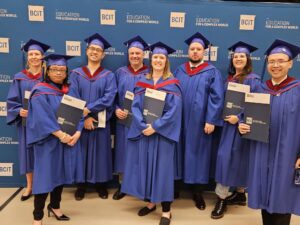
Congratulations to the recent Winter 2024 graduates; Matthew Beaulne, Paul Catroppa, Mike Dacre, Franklin Liao, Jason Liu, Julie Rasilainen, Tammy Savinkoff, Vir Sieunarine, Julie Suo-Anttila, and Maria Torillo.
Photo caption: (Back row, left to right) Julie Suo-Anttila, Jason Liu, Paul Catroppa, Matthew Beaulne, Julie Rasilainen, Franklin Liao (Front row, left to right) Maria Torillo, Tammy Savinkoff
MBA Option

Are you a BCIT Bachelor of Technology Management graduate with at least four years of full-time work experience? If so, you may qualify for Simon Fraser University’s Beedie School of Business Flexible MBA program, giving you the chance to advance your career with specialized coursework in Digital Transformation & Analytics, Innovation & Value Creation, and more.
The Flexible MBA is a part-time program designed for working professionals, providing comprehensive business training over 24 months. With classes held every Monday and Thursday evening, along with occasional weekend intensive sessions, this program is tailored to fit your busy schedule.
As an alumnus of BCIT’s Bachelor of Technology Management program, you may even qualify for a GMAT waiver when applying. Many of our graduates have transitioned smoothly into the MBA program and found it a powerful step toward career success.
Ready to learn more? Send your resume (or LinkedIn profile) and transcripts to mba_flexible@sfu.ca to connect with an advisor or schedule an advising appointment. You can also register for an MBA event to explore your options further.
Subscribe
Sign up to receive updates, invitations to events, and information about BCIT and your program.
We promise not to spam you, we won’t share your personal information, and you can unsubscribe at any time.
Programs and courses are subject to change without notice.