Overview
The Honours in Biotechnology is a unique Bachelor of Science program combining the world-class science curriculum available at University of British Columbia with the extensive industry-focused laboratory training available at BCIT. Co-operative education work terms provide practical training and an understanding of the biotechnology industry.
About the program
For more than 15 years, this joint program has prepared students with current scientific and technical expertise and the business and communication skills to start their biotechnology careers as soon as they graduate.
- Five-year, full-time Bachelor of Science Honours program
- Years 2 and 3 at BCIT set the foundation with in-class learning and applied lab skills
- Years 4 and 5 at UBC deepen your theoretical knowledge and application
- Co-op placement expands your learning with practical work experience

See Program Details for more information on BCIT and UBC’s Honours in Biotechnology program.
Who it’s for
This program is for individuals who:
- Have completed their first year of university or college
- Are willing and excited to work in a co-op placement
- Are interested in working in an interdisciplinary team environment
- Want to develop critical thinking and analytical skills
Find out more about entrance requirements and how to apply. Visit Entrance Requirements.
What grads can do
From research and development to medicine, business, and law our grads are finding biotechnology careers in many industries. Discover more at Graduating and Jobs.
Entrance Requirements
For general program information and information about supplemental documents contact:
Biotech@bcit.ca
For transcript and academic assessment information contact:
UBC Admissions
Tel: 604-822-9836
Application processing
Applications are accepted and processed by UBC Science as part of the second-year specialization process.
Application deadlines
UBC's application deadlines are:
- June for students accepted to the Faculty of Science
- January 31st for students transferring to UBC
Late applications will be considered on an individual basis.
Please see Apply to this Program for full details.
Selection process
Students are selected through the UBC Science second-year specialization. Candidates will be assigned to the Biotechnology specialization by considering completion of entrance requirements and academic achievement. Not all qualified applicants may be accepted. Specialization assignments are announced in late June by UBC Science. Students accepted into the Biotechnology program will be contacted by the Biotechnology Program Head and guided through the BCIT Admissions process.
Entrance requirements
Entrance requirements must have been completed within the past three years. To be eligible to apply to the Biotechnology specialization, applications need to meet the requirements for an honours specialization.
Option 1: 27.0 credits of first-year UBC courses or equivalent with a minimum 2.65 GPA:
- 8.0 credits of UBC Chemistry:
- CHEM 111 and CHEM 113 or
- CHEM 121 and CHEM 123
- 6.0 credits UBC Communications Requirement. Can include:
- ENGL 112 (recommended)
- SCIE 113 (recommended)
- 6.0 credits of UBC Biology. Two of:
- BIOL 112
- BIOL 111
- BIOL 121
- 3.0 credits of UBC Differential Calculus. One of:
- MATH 100
- MATH 102
- MATH 104
- MATH 110**
- MATH 120**
- MATH 180**
- MATH 184**
- 3.0 credit 100-level UBC Physics (PHYS) course*
- 1.0 credit elective
*PHYS 100 does not fulfill this requirement. Students require 3.0 credits of 100-level physics beyond PHYS 100. Students lacking Physics 12 must take PHYS 100 in first year. Another 3.0 credits of PHYS may be taken at any time during the specialization, but PHYS 100 must be taken during first year.
**MATH 120, 180 or 184 may be taken to fulfill the differential calculus requirement and will decrease the elective requirement by 1.0 credit. MATH 110 can also fulfill the differential calculus requirement and will decrease the elective requirement by 3.0 credits.
***STAT 200 is not acceptable as a computation elective because it is equivalent to a required course in BCIT's Honours in Biotechnology program.
-OR-
Option 2: Transfer credit from another university that includes:
- Two terms of first-year university courses (100 or 1000 level) in each of the following subjects:
- Biology
- Chemistry (with lab)
- English
- One term of first year university courses (100 or 1000 level) in each of the following subjects:
- Physics (energy and waves or electricity, light and radiation)
- Mathematics (differential calculus)
- Sufficient electives for an equivalent of 27.0 UBC credits
Note: Science credits at UBC are weighted differently than credits at some other colleges and universities because labs and extra work are credited separately. Where possible, applicants from colleges or other universities should take the first year equivalents of the listed UBC courses.
Apply to program
Already a UBC Science student?
Apply online by early June as part of the second-year specialization process (check UBC for deadline) if you are:
- A first year UBC science student, eligible to go into second year, GPA >70%
Apply directly to the UBC Department of Microbiology and Immunology by May 1st if you are:
- A UBC science student who has been registered as a second year student or higher, GPA >70%
To apply, email your name and UBC student number to micb.biot@ubc.ca or biotech@bcit.ca, and indicate your interest in joining the Biotechnology program for your third year.
Not yet a UBC Science Student?
Apply through UBC Admissions by January 31st if you are:
- a UBC student not in the Faculty of Science, GPA >70%
- a non-UBC student, GPA >70%
To apply, submit an Application for Admission or Application for Readmission/Change of Faculty form to UBC Admissions by no later than January 31st. Transcripts will be required for incoming transfer students.
Then, if you are admitted to second year, apply online by late June (check UBC for deadline).
If you are entering third year or are uncertain of your eligibility year, you can apply directly to the UBC Department of Microbiology and Immunology. To apply, email your name and UBC student number to micb.biot@ubc.ca or biotech@bcit.ca, and indicate your interest in joining the Biotechnology program for your third year by no later than May 1st.
Other students
If you have an average of less than 68% or you have failed courses then you are not eligible to register for an honours program. Students who significantly improve their GPA in second year may apply to the BCIT Biotechnology Program at biotech@bcit.ca by May 1st of the following year if there were no fails and there were extenuating circumstances for the weak grades.
Scheduled Intakes
September each year.
myCommunication
Within two business days of submitting your completed application, BCIT will send a message to your personal and myBCIT email addresses. All correspondence regarding your application will be posted to your online myCommunication account at my.bcit.ca. We will send you an email when a new message is posted. It is important to watch for these emails or regularly check your account online.
You can expect to receive communication concerning the status of your application within four weeks.
Costs & Supplies
Tuition fees
Use our tuition estimator to find tuition and fees for this program.
For more information on full-time tuition and fees, visit:
Students will pay tuition fees to the respective institute of attendance.
Books & supplies
Term 1: $641; Term 2: $376; Term 3: $826; Term 4: $581
(general estimated cost, subject to change)
Financial assistance
Financial assistance may be available for this program. For more information, please contact Student Financial Aid and Awards.
Courses
Program matrix
| Term 1 (15 weeks) | Credits | ||
|---|---|---|---|
| BIOT 0071 | Lab Safety | ||
| BIOT 3201 | Microbiology 1 | 6.0 | |
| BIOT 3210 | Introduction to Biotechnology | 5.0 | |
| BIOT 3250 | Introduction to Pharmaceutical Development | 3.0 | |
| BIOT 3260 | Principles of Animal Physiology | 6.0 | |
| CHEM 3338 | Organic Chemistry 1 for Biotechnology | 6.0 | |
| COMM 3343 | Communications for Biotechnology | 3.0 | |
| MATH 2444 | Basic Statistics and Information Technology for Biotechnology | 3.0 | |
| Term 2 (16 weeks) | Credits | ||
| BIOT 4201 | Microbiology 2 | 6.5 | |
| BIOT 4230 | Animal Cell Biotechnology | 6.5 | |
| BIOT 4260 | Plant Anatomy and Physiology | 5.5 | |
| CHEM 4438 | Organic Chemistry 2 for Biotechnology | 6.5 | |
| COMM 4443 | Communications Workshop | 3.0 | |
| MATH 4442 | Inferential Statistics and Research Methodology for Biotechnology | 5.5 | |
| Term 3 (15 weeks) | Credits | ||
| BIOT 5220 | Molecular Genetics 1 | 6.0 | |
| BIOT 5230 | Advanced Plant Cell Biotechnology | 5.0 | |
| BIOT 5240 | Biochemistry 1 | 6.0 | |
| BIOT 5361 | Process Systems | 6.0 | |
| CHEM 5509 | Analytical Chemistry 1 | 5.0 | |
| Term 4 (16 weeks) | Credits | ||
| BIOT 6201 | Microbiology 3 | 6.5 | |
| BIOT 6220 | Molecular Genetics 2 | 6.5 | |
| BIOT 6240 | Biochemistry 2 | 6.5 | |
| BIOT 6275 | Pharmaceutical Development and Management | 3.0 | |
| BUSA 7250 | Management Skills and Applications | 3.0 | |
| CHEM 6609 | Analytical Chemistry 2 | 5.5 | |
| LIBS 7020 | Bioethics | 3.0 | |
| Co-op Work Terms (16 weeks) | Credits | ||
Co-op work terms are completed in the 16 weeks following Terms 2 and 4. Students must complete at least one of the following co-op work terms. Completion of both work terms at BCIT is strongly encouraged. If only one co-op term is completed at BCIT, you must complete two co-op terms at UBC to graduate with a Bachelor of Science Honours in Biotechnology from UBC. |
|||
| BIOT 4990 | Co-op 1 | 16.0 | |
| or | |||
| BIOT 6990 | Co-op 2 | 16.0 | |
| Total Credits: | 143.5 | ||
Terms 5-7
For a listing of UBC courses (Terms 5-7), please refer to section “Fourth and Fifth Years” course listings on the UBC Biotechnology website.
Full course descriptions for UBC terms are available at vancouver.calendar.ubc.ca/course-descriptions.
Transfer credit
Do you have credits from another BC/Yukon post-secondary school? Do you want to know if they transfer to courses here at BCIT? Check out BCIT's Transfer Equivalency Database to find out.
Program Details
The Honours in Biotechnology program is intended to produce students with strong scientific and technical backgrounds who are also well schooled in business and communications.
The program addresses the documented need for people who can combine technical experience and training with expertise in other areas such as management, production, regulations and intellectual property. It provides a core set of skills that are important for employment in the biotechnology industry, government agencies or academic research labs, as well as for acceptance into graduate school. BCIT and UBC’s joint program recognizes the need for cross-discipline training and fosters collaborative interactions that strengthen undergraduate education.
The program is specifically designed to:
- develop adaptable students with the critical thinking skills that are relevant to the changing world of biotechnology
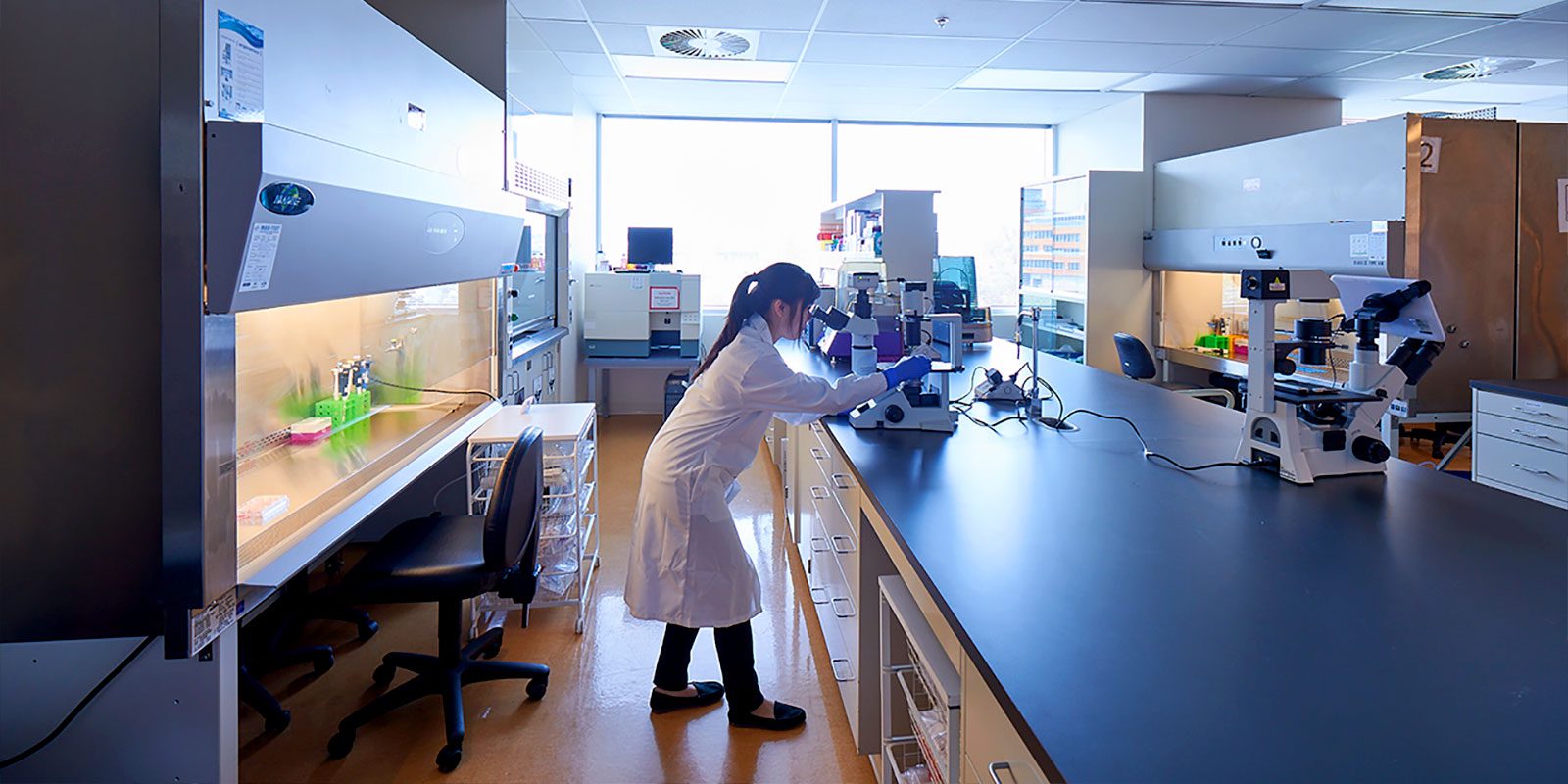
- provide students with practical training in the skills and techniques of biotechnology, who can work confidently in a laboratory environment
- integrate the laboratory and lecture components of the program through the use of an experiential approach to learning
- uniquely combine BCIT’s strength in providing practical, hands-on biotechnology training with UBC’s strength in leading-edge biotechnology research and teaching.
Program length
Four years, full-time
BCIT offers Academic Terms 1 to 4. The program continues at UBC for Academic Terms 5 to 7.
Program delivery
In person: This program is delivered on campus.
Program location
Terms 1–4:
Burnaby Campus
3700 Willingdon Avenue
Burnaby, BC
Terms 5–7:
University of British Columbia
2329 West Mall
Vancouver, BC
Program structure
| Program Component | BCIT Credits | Degree Credits |
| First year (Pre-entry) | Minimum 27.0 | |
| BCIT academic terms 1-4 | 127.5 | 60.0 |
| UBC academic terms 5-7 | 42.0 | |
| Co-op work terms 1-2 (BCIT) | 32.0 | |
| Co-op work terms 3-4 (UBC) |
* credit values may vary depending on prerequisite institute attended
Promotion Requirement
In order to continue to Term 5 of the program at UBC, students are required to maintain an overall average of 68 per cent in the four academic terms taken at
BCIT.
Note: BIOT courses listed in the UBC Calendar are offered only at BCIT. The UBC equivalents are listed for your information only and are not open for registration.
Co-operative education
Students entering the biotechnology program will have the opportunity to obtain work experience with our industry partners, private biotech companies, and government agencies over the course of their training. Co-op education is a mandatory part of the program and students are required to complete three work terms of four months each (12 months total) to graduate, although all students are encouraged to complete four work terms. They must also complete at least one of the work terms at BCIT.
For more information visit the Centre for Workplace Education
Graduating & Jobs
Our grads are ready
Science. Innovation. Business. Three of the many paths grads can take with a career in biotechnology. With this combined, cutting edge education, you will graduate ready to work in a multitude of life science opportunities.
Career opportunities
On their career path, our grads can choose from a variety of areas, including:
- Life sciences research
- Biotechnology industry
- Pharmaceutical development
- Health care support services
- Regulation and quality assurance
- Intellectual property law
- Natural resources and agriculture
- Business development and operations
Our alumni are employed in a variety of fields. Read the Biotechnology Program FAQ on the UBC-BCIT Biotechnology Club website to find out about the many employment paths and opportunities upon graduation.
Keep learning
Continue to advance your education. Honours in Biotechnology grads can go on to get an MSc, PhD, MD, or MBA.
Graduate employment outcomes
The BCIT student outcomes report presents summary findings from the annual survey of former students administered by BC Stats one to two years after graduation. These reports combine the last three years of available results for the 2022-2024 BCIT Outcomes Surveys of 2021-2023 graduates and for Degree 2020-2022 graduates. The reports are organized into three-page summaries containing information on graduates’ labour market experiences and opinions regarding their education. More detailed information can be accessed at the BC Student Outcomes website.
To view these results, you may need to have the Adobe Acrobat Reader installed in your Web browser.
Credential
Upon successful completion of the four BCIT academic terms, students will receive a Diploma in Biotechnology.
Upon successful completion of the program, students will receive a Bachelor of Science Honours in Biotechnology.
Faculty, Advisors & Staff
Sarah McLeod, BSc, PhD
Program Head
Tel: 604-432-8955
Email: Biotech@bcit.ca
Subscribe
Sign up to receive updates, invitations to events, and information about BCIT and your program.
We promise not to spam you, we won’t share your personal information, and you can unsubscribe at any time.
Programs and courses are subject to change without notice.