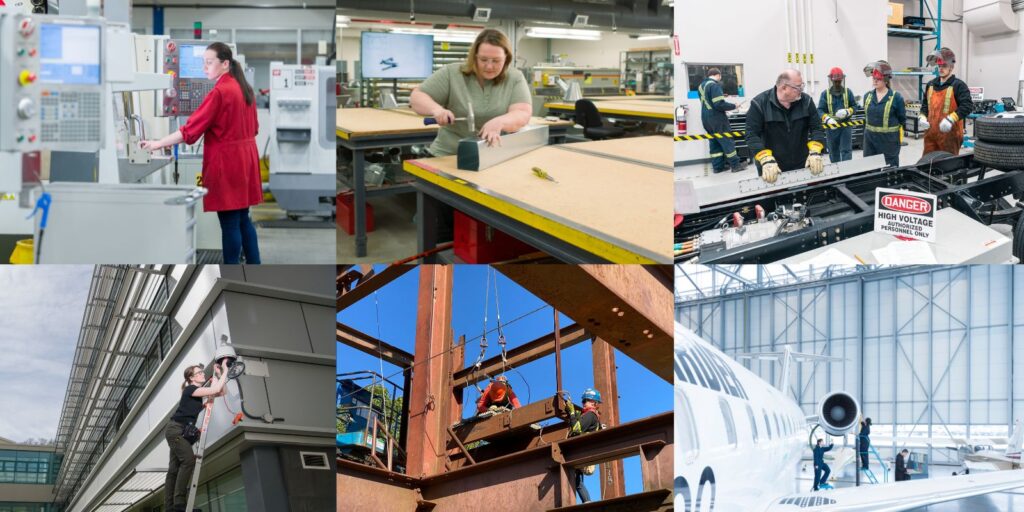
With expansions across Canada’s infrastructure, transportation, and clean energy projects, the demand is rising for skilled trades professionals to build, power, and maintain the systems that keep the country moving and growing. In British Columbia (BC) alone, more than one million job openings are expected over the next decade, with trades and transportation projected to rank among the top five occupational groups that account for nearly 80 percent of the total job openings.
BCIT, the largest trades training provider in Western Canada, provides students with the job-readiness employers are looking for. Graduates see exceptional outcomes, with a 97% employment rate for apprenticeship completers and 93% for trades foundation and trades-related vocational program graduates*.
Whether you’re a high school graduate or considering a career change, here are 10 programs that prepare you for an in-demand trades career in BC:
Aircraft Maintenance Engineer (Structures)
The Aircraft Maintenance Engineer – Structures (AME-S) program is a full-time, 10-month diploma designed for students who love hands-on technical work and have a passion for aviation. Students will learn how to safely use industry tools, interpret structural repair manuals and schematics, perform corrosion control and surface finishing, and apply metallurgy treatments on real aircraft structures.
Upon completing the program, graduates earn a diploma and credit toward their Transport Canada AME license. Graduates find opportunities in maintenance and overhaul facilities or even on specialized assignments around the world. If you’re detail-oriented, enjoy problem-solving, and want to play a direct role in keeping aircraft safe and flight-ready, this program offers a clear, exciting pathway into the aviation industry.
Boilermaker
The Boilermaker Foundation Certificate prepares students to work hands-on with large metal structures like tanks, vessels, and hoists. Boilermakers set up and operate brakes, rolls, shears, flame cutters and other heavy metal products and drill and install boilers according to specifications using hand and power tools.
Students in the program learn to assemble and repair boilers and other heavy structures using brakes, rolls, shears, flame cutters, and more, combining theory with hands-on shop practice. Foundation graduates are eligible to seek employment as apprentice boilermakers.
Computer Numerical Control (CNC) Machinist Technician
BCIT is the largest provider of CNC machinist education and training in BC. The Computer Numerical Control (CNC) Machinist Technician Diploma is ideal for students who are looking to gain hands-on skills working across the manufacturing industry. Students gain real-world experience through a 33-week industry co-op, with many students securing paid positions.
CNC is an essential part of modern manufacturing, using Computer-Aided Manufacturing (CAM) software to design and produce products. BCIT graduates gain hands-on skills that prepare them for a successful career in the machinery industry, including research, manufacturing, CNC programming, sales, and quality control.
Heavy Duty Truck Technology
The Heavy Duty Truck Technology Diploma prepares students for apprenticeships, manufacturer certifications, and growing opportunities in electric vehicle (EV) technology. As BC’s fleets shift toward electric and zero-emission trucks, students gain hands-on experience across four terms and a 15-week paid co-op, building skills in brakes, hydraulics, electrical diagnostics, and engine repair.
Graduates can pursue a range of technician and service management roles, equipped to work on both traditional diesel engines and next-generation electric trucks. As fleets modernize, skilled technicians who understand high-voltage systems and evolving diagnostics will be in high demand. Students also have the option to return and complete a Bachelor of Technology Management Degree in as little as three years.
Industrial Instrumentation and Process Control Technician
For students looking to work hands-on with mechanical and electrical equipment, the Industrial Instrumentation and Process Control Technician Diploma provides a strong foundation. This program trains students to install, repair, calibrate, and tune industrial measurement and control systems, while gaining experience with pressure, temperature, flow, and level control equipment commonly used in industrial settings.
Graduates are well positioned to gain employment as technicians in the instrumentation and control field across diverse industries such as oil and gas, pulp and paper, mining, food processing, shipbuilding, and more.
Industrial Mechanic (Millwright)
Students looking to pursue a millwright career may be interested in the Industrial Mechanic (Millwright) Foundation Certificate. This full-time credential trains students to develop the technical skills required in the mechanical field, including machinery installation, maintenance, and troubleshooting.
With a focus on applied learning, this program equips graduates with the technical knowledge and hands-on experience needed to begin a successful career in the trades. This qualification prepares students for jobs in mining, pulp mills, wood processing and petrochemical plants. As industrial operations continue to rely on skilled mechanics to maintain complex equipment and minimize downtime, industrial mechanics remain in steady demand across resource, manufacturing, and processing sectors.
Ironworker
The Ironworker Foundation Certificate equips students with the essential safety knowledge and hands-on skills needed to enter entry-level employment in the ironworking trade.
Ironworkers assemble and secure structural members made of steel, concrete, and timber to create the framework of buildings and other structures. They work on projects such as high-rises, bridges, dams, and industrial facilities, as well as specialized projects in power generation, solar and wind energy, and energy transmission.
The Ironworker program prepares graduates for strong employment opportunities across commercial, industrial, and infrastructure construction sectors. Graduates who go on to complete their apprenticeship and required industry hours can eventually earn provincial certification and the Interprovincial Red Seal endorsement.
Nautical Sciences
The Nautical Sciences program, accredited by Transport Canada, is the first step to take in becoming the captain of your own ship. This full-time, three-year program combines academic study with co-operative learning to give students (cadets) the practical experience needed to operate navigational equipment, safe cargo handling, watchkeeping, and marine communication.
Students also gain a strong foundation in the principles and operation of modern vessels, including supertankers, bulk carriers, cruise ships, tugboats, and offshore supply vessels.
Graduates are prepared for careers as Deck Officers and earn a Transport Canada Watchkeeping Mate Certificate of Competency.
Security Systems Technician
The Security Systems Technician (SST) Certificate program offers a pathway into a rapidly growing field of advanced electronic systems protecting people and property. As security needs continue to expand across airports, schools, retail spaces, and residential settings, skilled technicians are increasingly in-demand to install and maintain electronic security systems.
Graduates are trained to work with alarm systems, surveillance cameras, card access systems, personnel monitoring equipment, and home automation technologies. As the first program of its kind in North America, the Security Systems Technician program holds a distinctive reputation within the security industry. Employers frequently seek out BCIT graduates when hiring – recognizing the program’s strong technical foundation and industry-aligned training.
Sheet Metal
The Sheet Metal Foundation Certificate program equips students with the skills needed to start an apprenticeship and advance in the sheet metal trade. Students learn heating, ventilation, and air conditioning across residential, commercial, and industrial settings, as well as specialized areas such as stainless steel, industrial exhaust systems, architectural work, and roofing. Core skills include safe work practices, applied trade mathematics, and understanding different metals and their properties.
Students who complete the certificate program are prepared for entry-level employment in the sheet metal trade, or they may seek employment as apprentices.
Accessible pathways to an in-demand trades career
BCIT is committed to fostering an inclusive and supportive learning environment where all students thrive. This includes providing accessible pathways to learning, such as through the Trades Discovery for Women program where students explore a dozen trades in 16 weeks. The program builds a strong skilled trades workforce while creating an accessible pathway for underrepresented groups and giving industry early access to a diverse talent pool.
Throughout students’ educational journey, they also have access to supports like the ConnectHER Hub which provides a welcoming and resourceful space for women and gender-diverse trades students.
Financial support, including a scholarship from Canerector Foundation, is also available to eligible students enrolled in a BCIT trades foundation program.
Explore trades and apprenticeships programs to get the hands-on skills to build a trades career.
(*Source: BC Student Outcomes, prepared by BC Stats, 2024)