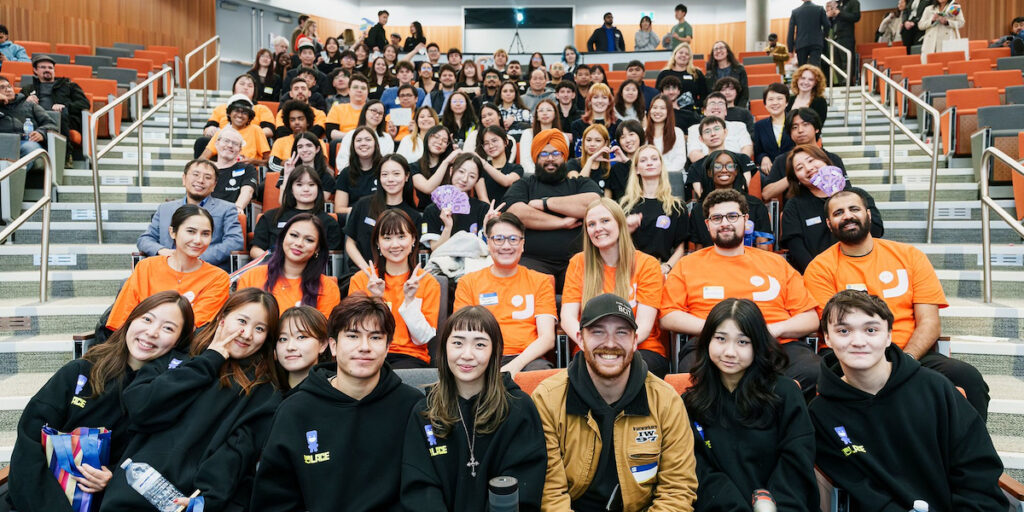
BCIT students are putting their digital design, development, and artificial intelligence skills into practice through applied learning projects developed in collaboration with industry and community partners.
More than 90 students from the BCIT Digital Design and Development (D3) and Full-Stack Web Development (FSWD) diploma programs collaborated with the BCIT ConnectHER Hub to develop AI-driven prototype apps that help address challenges faced by women and gender-diverse apprentices in the skilled trades.
With guidance from industry experts and project advisors, student teams explored topics including navigating the apprenticeship journey, childcare barriers, injury prevention, support for neurodiverse apprentices, workplace safety, and fostering more inclusive work environments.
Among the projects showcased
Gold – SafeSpace
SafeSpace is an app designed to help women and gender-diverse people in the trades foster safer, more inclusive work environments. The AI-powered solution summarizes anonymous worker reports and generates practical recommendations to help improve workplace conditions. The team was advised by Chris Ernst, an electrical apprentice completing technical training at BCIT.
Silver – Solace
Solace addresses the physical demands of ironwork, including long days, heavy strain, and recovery challenges. The AI-powered solution provides personalized recovery plans, gamified wellness rewards, and a companion mascot that evolves with the user’s progress. Its goal is to encourage healthier routines that support recovery, sleep, and mental resilience. The team was advised by Kenner Anderson, a Red Seal Ironworker and instructor in the BCIT School of Construction and the Environment.
Bronze – Scaffold
Scaffold is an AI-powered funding platform for trades students and apprentices across BC. It brings funding opportunities together in one place – matching users with relevant grants and providing templates to simplify applications. Ultimately, apprentices spend less time searching for financial support and more time focusing on their training and careers. The team’s advisor was Yuqi Yang, a Flexible Learning instructor and researcher in the BCIT School of Health Sciences.
Cross-disciplinary expertise drives innovation
“The creativity and dedication demonstrated by our students was inspiring,” said Henry Leung, Program Head for the Digital Design and Development program. “These projects show how applied learning can help students develop digital solutions that address real challenges in our communities.”
For Anna Lary, Founder and Project Lead, ConnectHER Hub, the collaboration demonstrated the value of bringing students with different backgrounds together to tackle complex challenges.
“As a tradeswoman who has spent 30 years attempting to tackle the systemic barriers that persist in many trades environments, this collaboration held deep personal significance for me,” said Anna. “I was so impressed by students who came together, built a shared understanding of the challenges despite their very different pathways, and developed informed, practical solutions. Sitting in the audience at the Showcase, I was fiercely proud to be part of the BCIT community, with its diversity and its strength.”
The showcase brought together collaboration across three BCIT schools: the School of Business + Media, the School of Computing and Academic Studies, and the School of Construction and the Environment, along with faculty, staff, students, and community partners. While all of the prototype apps are functional, none are currently planned for live launch.
Partnering with industry to solve organizational challenges
BCIT is continuing to expand opportunities for students to work with organizations on real-world challenges.
In 2026, BCIT School of Business + Media is working with the Tri-Cities Chamber of Commerce and its members on applied learning projects, with a showcase planned for December. The collaboration will build on the same model of connecting students with industry and community partners to explore challenges and develop practical digital solutions.
More details about the participating organizations and student projects will be shared following the December 2026 showcase.
These collaborations demonstrate the value of applied learning at BCIT, giving students opportunities to bring their technical, creative, and problem-solving skills to challenges beyond the classroom while offering organizations a fresh perspective on digital innovation.
Students involved in the BCIT Digital Design and Development program develop skills in areas including UI/UX design, front-end web development, digital design, and project development, preparing them to apply their technical and creative skills to real-world challenges.
Learn more about BCIT’s two-year full-time Digital Design and Development (D3) diploma program, at the BCIT School of Business + Media.