At BCIT, the IDEAS Lens (Indigenous, Inclusion, Diversity, Equity, Access, Sustainability, and Student Wellbeing) provides a foundation for how we work, collaborate, and relate across the Institute. At its core, it reflects how we show up for one another. It’s our shared commitment to reconciliation, inclusion, and creating supportive, sustainable spaces where people can thrive.
Through the Our People series on BCIT News, we celebrate individuals who help bring these values to life.
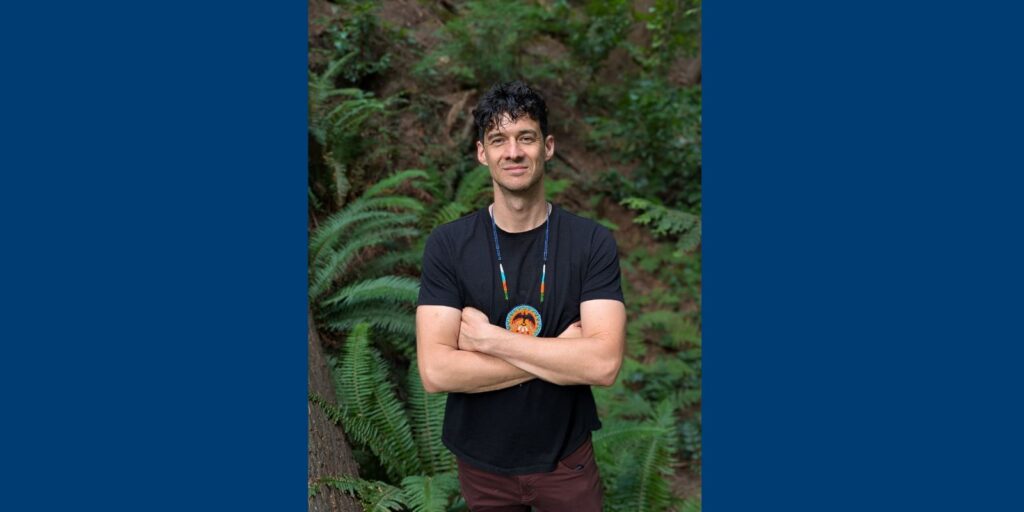
Meet Derek Fiddler, a BCIT Master of Science in Ecological Restoration alum and Project Leader at the BCIT Zero Energy and Emissions Building (ZEB) Learning Centre. Derek is a builder, educator, and innovator who has spent his career exploring how things work and how ideas can be transformed into real-world solutions. From supporting retrofit and high-performance building training in Indigenous communities to developing new approaches for affordable, energy-efficient housing, Derek’s work connects building science, hands-on learning, innovation, and Indigenous capacity building.
What does your role entail?
I have been working at BCIT for four years. My role is a bit hard to put in one box, which is honestly the part I enjoy most.
At the Zero Energy Building Learning Centre, I help turn ideas into things people can actually build, test, teach, and use. My work moves between lab management, hands-on training, curriculum support, mock-up design, prototyping, applied research, grant ideas, tours, events, and community-based projects.
A lot of my work happens behind the scenes: figuring out what is possible, what needs to be built, who needs to be involved, what materials or tools we need, and how to make the idea work in real life.
I have also travelled to remote First Nations communities to support retrofit and high-performance building training, and I am currently involved in developing off-site construction training at BCIT, with a focus on building capacity for First Nations communities to construct affordable, energy-efficient homes.
The work I am most drawn to sits at the intersection of building science, hands-on learning, innovation, and First Nations capacity building.
Tell us about your journey.
I am Cree and from Waterhen Lake First Nation in Saskatchewan. My career path has definitely not been linear, but over time I have come to see that as one of my strengths.
I hold a Master of Science in Ecological Restoration from BCIT and SFU. My background moves through aviation, conservation, ecological restoration and research, carpentry, teaching, and high-performance building.
For a long time, I felt like I had to choose between being hands-on, technical, creative, or academic. I eventually realized I did not need to separate those parts. I like systems, details, tools, research, design, and technology. I’m most interested in understanding how things work and operating in the space between “What if?” and “Okay, how do we actually do this?”
What does National Indigenous History Month mean to you?
It is an important reminder of the need for learning, listening, and open conversations.
What is one perspective that you’d like to share with colleagues?
I would encourage colleagues to stay curious and look for meaningful ways to include Indigenous histories and perspectives in their own work and teaching.
For me, Indigenization is about being seen, not singled out. It works best when Indigenous perspectives are woven naturally into the curriculum, rather than added as a separate or disconnected piece. It does not need to be loud or forced to be meaningful. Small, thoughtful choices can have a real impact, and the willingness to keep learning matters more than getting everything perfect the first time.
My mom has been unwavering in her support for me to find meaningful work and pursue different educational and career paths. Her encouragement gave me the security I needed to try different things, fail, pivot, and try again.
I am also grateful for the mentors, colleagues, and community members I continue to learn from. I work with a supportive team that challenges me to grow, and I regularly meet people whose dedication and knowledge inspire me.
Did you know? The Zero Energy and Emissions Buildings (ZEB) Learning Centre supports the construction industry with training in Net-Zero Energy and Zero Emissions design and construction, energy management, and building retrofits. Explore training and courses available, including customized group training.