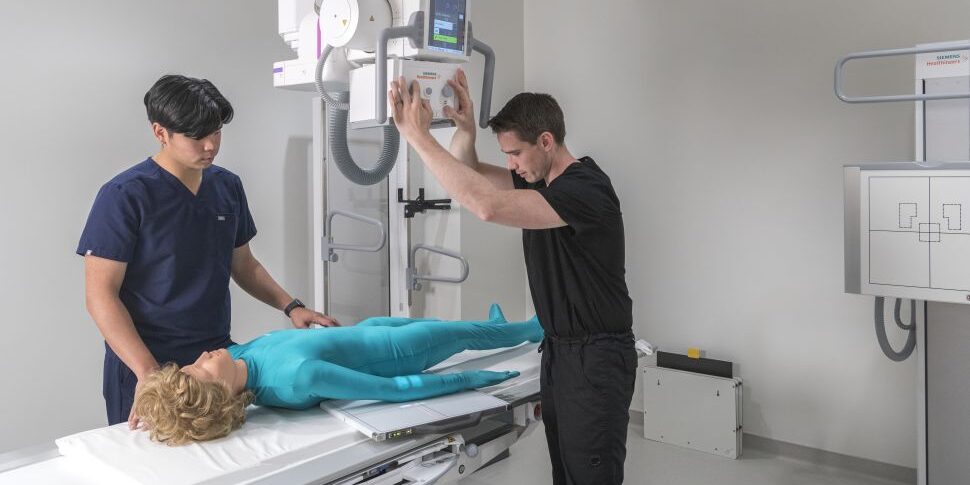
BCIT School of Health Sciences offers many well-known programs to launch a career in health sciences, but what many high school students don’t realize is that several of these programs are open to students straight out of Grade 12.
For high school students who already know they want a future in healthcare and are ready to begin their careers, the British Columbia Institute of Technology (BCIT) offers multiple pathways into the high-demand world of health sciences.
1. Medical Radiography: A direct path after graduation
One of the most accessible and in-demand options for high school grads is the BCIT Medical Radiography Diploma – a two-year, full-time program that prepares students to work with X-rays, CT, and fluoroscopy in hospital and clinical settings.
Applicants with solid academic performance may apply straight out of high school with at least 73% in English Studies 12, Pre-Calculus 12, and Anatomy & Physiology 12. Experience in lab sciences and familiarity with anatomy and healthcare environments is a plus. Students can apply using midterm marks in Grade 12 but are required to complete prerequisites before the program begins.
Graduates are job-ready and in high demand, with BCIT citing strong placement rates in B.C.’s growing healthcare system.
2. Diagnostic Medical Sonography: High competition, high reward
The BCIT Diagnostic Medical Sonography – which trains students in ultrasound imaging – is also open to qualified high school grads. This program is one of the most competitive programs to get into, requiring strong grades in English, math, biology, and physics. Some science courses must be taken within the last five years, and applicants often strengthen their chances with volunteer or patient-care experience.
The program spans approximately two years, varying slightly by specialization in general, cardiac, or dual sonography. Students will be prepared for a challenging but rewarding academic journey during their time at BCIT, with both classroom and clinical components.
3. Magnetic Resonance Imaging (MRI)
Another two-year program to consider in the diagnostics portfolio is Magnetic Resonance Imaging (MRI). MRI uses powerful magnetic fields and radio waves to form high-resolution images of the body to diagnose illnesses and pathologies.
Upon graduation, students find work at major hospitals and clinics throughout Canada.
With similar pre-requisites to other diagnostic programs, students will want to aim for high marks in English 12, Pre-Calculus 12, Anatomy and Physiology 12, and Physics 12.
To help strengthen your application, consider work or volunteer experience in a healthcare setting, such as a hospital or long-term care facility.
4. Nuclear Medicine
While the BCIT Nuclear Medicine program is not as well-known as some of the other diagnostic programs, it’s a fast-growing discipline in British Columbia (BC). Using biological tracers combined with radioactive material, nuclear medicine produces images that help diagnose and manage disease. Nuclear Medicine stands out for its ability to detect subtle changes in the body’s function, allowing for early detection of a wide range of disorders.
Applicants will need a strong background in high school sciences including Anatomy and Physiology 12, Chemistry 12, Physics 11 and Pre-Calculus 12.
5. Cardiology Technology: A blended option
If you prefer to study mostly online or do not live in the lower mainland, you can also check out the BCIT Cardiology Technology program. This program uniquely offers all its theory courses online, with and additional 2 weeks of face-to-face lab activities at the BCIT Burnaby campus. Short term housing at the new BCIT Tall Timber Student Housing is an opportunity to try on-campus life. Students can then complete their clinical placements at a variety of hospitals across Canada. It is possible to do your clinical placements at or near where you live.
Cardiology technologists work in hospitals performing non-invasive diagnostic heart tests like ECGs, Holters, and stress testing. This program also lends itself to continued education post-graduation in advanced areas of Cardiovascular Technology, Electrophysiology Technology or Cardiac Rhythm Device Technology.
Successful applicants to this program will have high marks in Pre-Calculus 12, Anatomy and Physiology 12, Physics 11, and Chemistry 12.
6. Medical Laboratory Science
If one-to-one patient care isn’t for you but you enjoy working in a lab environment, consider BCIT Medical Laboratory Sciences (MLT) program. This two-and-a-half-year diploma program prepares students to work in hospitals and private laboratories conducting diagnostic tests on tissue samples, blood, and other bodily fluids. The tests MLTs perform help make medical diagnoses so patients can receive the best possible forms of treatment and care.
Pre-requisites for this program include strong marks in English 12, Pre-Calculus 12, Anatomy and Physiology 12, Chemistry 12, and Physics 11.
7. Other options: Biomedical Engineering and beyond
Beyond patient care, BCIT also offers a diploma program in Biomedical Engineering Technology.
This program is for individuals who are interested in technology and health sciences.
Biomedical Engineering Technologists work behind the scenes in hospitals making sure the medical devices and technologies used to diagnose, treat, and sustain patients are always in optimal working conditions. Some graduates from this program also pursue careers in developing innovative medical devices and products.
Applicants to the Biomedical Engineering Technology program will want to make sure they have good marks in Pre-Calculus 12, Physics 12, and Chemistry 11.
If you’re not looking to work in hospital but you’d still like to have an impact on the health and safety of Canadians, consider the BCIT Food Processing, Quality and Safety program. Graduates of this program ensure food companies are producing safe and high-quality foods. Students learn to analyze food composition, study processing methods, determine shelf life, and develop innovative new food products.
Students should consult BCIT’s program websites for specific entry requirements.
Exploring Health Science careers before graduation
Alongside these diploma programs, BCIT is also introducing two new short course options designed specifically for high school students. Launching in Spring/Summer 2026, these pilot courses give potential applicants a chance to explore healthcare before committing to a full diploma:
- Healthcare Horizons: A dynamic badge course for students in grades 10–12 who want to discover the diverse world of healthcare careers.
- Preparation for Nursing Education: Tailored for students in grades 11–12 considering a future in nursing, this course helps build a strong foundation before entering post-secondary nursing programs.
Both courses are meant to spark interest and provide early exposure to healthcare pathways, making them an excellent option for students who want to test the waters before diving into a full diploma program.
Students and parents can sign up for updates and registration alerts through BCIT’s Preparation for Health Careers page.
Tips for high school students thinking of applying
- Ensure you’re taking the required high school science and math courses early so you don’t scramble later.
- Attend an online info session or come visit us in person at the annual BCIT Big Info event to learn more about the program(s) you’re interested in.
- Keep grades up: many health sciences programs are competitive. Strong performance in science and math helps a lot.
- Get some volunteer or work experience in a public-facing or patient care setting.
- Reach out to BCIT program advisors early to make sure you understand specific entrance requirements for the program you want.
- Be curious! Explore the many programs we offer and reflect on your strengths and where you think you will enjoy working in the future.
- Be sure you are or will continue to work on being an effective communicator, preparing to be part of a healthcare team.
Healthcare careers are in demand. The BCIT Health Sciences Centre, which opened in 2022, offers advanced simulation labs that mirror real hospital environments, giving students hands-on experience so you’re ready for clinical practice.
To learn more about BCIT School of Health Sciences check out our full program listing.