
For almost three decades, BCIT Forensic Science graduate and South African-born Stephen Fonseca has worked around the world in conflict and disaster zones. His mission is to identify the dead and help provide answers for families searching for loved ones. Recently, that work earned him one of the profession’s highest honours.
“People always say that we speak for the dead. We’re not. We speak for the living while protecting the dignity of the dead.”
During May’s 24th Triennial Meeting of the International Association of Forensic Sciences (IAFS) in Sofia, Bulgaria, Stephen received the IAFS Human Rights Award. The award recognizes individuals who have made exceptional contributions to human rights through forensic science.
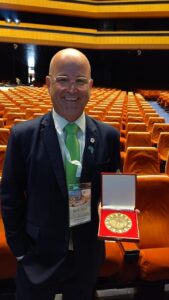
“I still don’t think the award is mine,” Stephen says from his office in Pretoria, South Africa. “I’m surrounded by a ton of people who have not been acknowledged. If anyone deserves the award, it is the African practitioners, because they have allowed me to work collaboratively with them across this amazing continent.”
The nomination was championed by the African Forensic Sciences Academy (AFSA). Dr. Antonel Olckers, AFSA’s President, wrote after the nomination’s success: “Congratulations, Stephen, the award is well deserved! Widely regarded as the face of humanitarian forensics in Africa, you have spent the past three decades helping bring dignity to the missing, the unidentified dead, and their families. Through your leadership, forensic science has remained grounded in empathy, justice, and service to affected communities. All of us in Africa celebrate this prestigious international recognition with you.”
Why identification matters
Forensic science is often associated with crime scenes and television dramas. But for Stephen, its purpose is far more human.
“With continuing armed conflict, humanitarian disasters, infectious disease outbreaks, mass migration on often deadly land and sea routes, and human trafficking, the number of unidentified dead bodies continues to grow,” Stephen says.
For Stephen, identification represents one of the most fundamental human rights.
“The consequences of failing to identify the dead extend far beyond the individual,” he explains. “Families are often left in a state known as ambiguous loss – the psychological distress that comes from not knowing whether a loved one is alive or dead.”
“People keep holding out hope. They keep searching. They keep waiting. Not only is that unfair, but it can also have severe negative effects on a person’s well-being.”
Speaking for the living
Identification also carries significant legal implications, Stephen explains.
“Death certificates may be required to settle estates, access benefits, transfer parental responsibilities, or begin administrative processes after the loss of a family member. Criminal investigations may also stall if victims cannot be identified.”
“At the end of the day, it has to involve the families,” Stephen says. “I wish I could bring someone home alive. The next best thing is providing reliable answers so families can begin mourning, seek support, and start rebuilding their lives.”
“People always say that we speak for the dead. We’re not. We speak for the living while protecting the dignity of the dead.”
A career shaped by curiosity and compassion
Growing up in South Africa, Stephen became fascinated by forensic science and convinced a Johannesburg-based government forensic pathologist to let him observe her work.
“There were bodies everywhere,” Stephen recalls. “But what struck me was her humanity. She was a brilliant forensic pathologist, but she still had so much compassion.”
That combination of technical expertise and empathy would shape his entire career.
After immigrating to Canada in 1995 at age 25, Stephen enrolled part-time in the Forensic Science program while pursuing a career in death investigation.
“I loved the program,” he says. “Everything that I was taught came from instructors who had worked directly in the field. They were teaching what actually happens. It made sense.”
Unlike more theoretical academic programs, BCIT’s applied approach aligned with the career he wanted to build.
“I didn’t need to become a professor,” Stephen says. “I wanted to become an investigator.”
Building a foundation in British Columbia
While completing his studies, Stephen joined the British Columbia (BC) Coroners Service in 1998, where he helped establish and manage BC’s Identification and Disaster Response Unit (IDRU). He also contributed to the development of the province’s first coroner service-managed DNA database – an initiative spearheaded by Dr. Dean Hildebrand, now Dean of BCIT’s School of Computing and Academic Studies.
Stephen’s work earned provincial and national recognition, including the Queen Elizabeth II Diamond Jubilee Medal in 2012.
Yet despite his success in BC, an unexpected opportunity would ultimately reshape his career.
A temporary assignment that changed everything
In 2013, Stephen accepted what he thought would be a temporary assignment with the International Committee of the Red Cross (ICRC). “For 16 years, my whole world was British Columbia,” he says. “I honestly thought I’d take a break for a year and then come back.”
Instead, he found himself working in the Middle East stationed in Lebanon. “Working in this international environment was so different and so challenging,” says Stephen. “It was just something I couldn’t leave.”
After two years in Lebanon, an opportunity arose to support the ICRC’s work across Africa. “When I started in 2015, I was the only forensic specialist for the ICRC in all of Africa.”
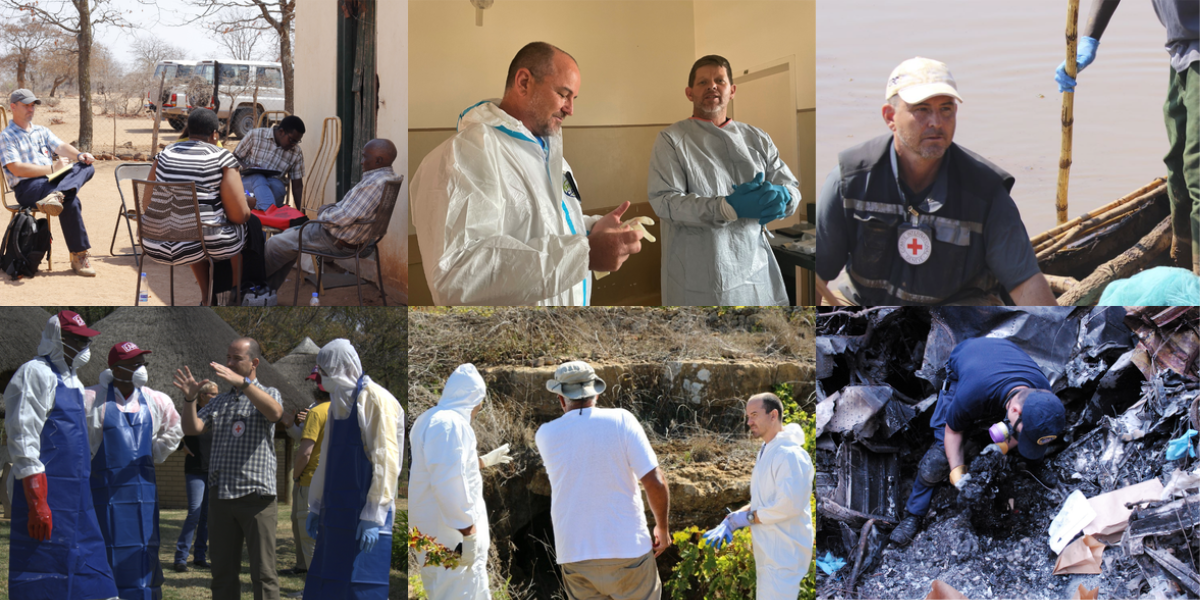
One example of that work came in 2019, when Cyclone Idai – one of the deadliest tropical cyclones in the Southern Hemisphere – struck Mozambique. Stephen was the only foreign body-recovery specialist deployed to assist communities in some of the hardest-hit rural areas. More than 1,500 people died, and many more were missing.
Building systems before tragedy strikes
Today, Stephen serves as Head of the African Centre for Medicolegal Systems (ACMS), working with governments, forensic practitioners, law enforcement agencies, military organizations, health authorities, and disaster managers to improve preparedness for conflicts, disasters, migration events, and mass-fatality incidents.
A key focus is ensuring that systems are in place before tragedy occurs.
“If it’s not supported by legislation, it becomes very improvised,” he says. “Training alone is not enough if governance structures don’t support the work.”
Stephen has seen the consequences firsthand.
During one conflict-related recovery operation, he and a colleague worked in an area measuring roughly 500 metres by 500 metres. “We recovered 6,000 human remains,” he recalls. “When systems are not in place before a crisis occurs, families can spend years – or even generations – searching for answers.”
Navigating the challenges of forensic investments
Much of Stephen’s work involves helping decision-makers understand the importance of investing in forensic and medicolegal systems, which is not always an easy conversation to have.
“In many countries, they’re correctly focused on keeping people alive,” he says. “So asking them to invest in the dead can be a hard message to deliver.”
The role requires him to move constantly between countries, learning how different governments, legal systems, cultures, and religions approach death investigation and identification.
“There was just so much to take in when I started working in Africa,” he says. “But now, after more than a decade and a network of thousands of professionals and practitioners, it is much easier to engage with senior levels of governance.”
Improving battlefield identification
One of Stephen’s most ambitious initiatives is the Military Personnel Identification (MPI) Project, aimed at reducing the number of military personnel who go missing or become unaccounted for in armed conflict.
In collaboration with nearly seventy military and subject-matter consultants, the project explores how identification responsibilities can be moved closer to the battlefield through measures such as battlefield-level identification, grave registration services, temporary burial procedures, and accountability systems for missing-in-action and killed-in-action personnel on all sides of the armed conflict.
The initiative also encourages armed forces to collect identifying information, such as descriptive features, fingerprints, and DNA, and to issue ID cards and identification discs (‘dog tags’) before deployment.
“If you’re going to put men and women on the front line and at risk, the very least you can do is ensure they have something that identifies them,” Stephen says.
He describes these measures as an insurance policy – something no one hopes to use, but invaluable when tragedy occurs.
The project is in its final stages, and Stephen will present the military identification guidelines – adaptable for use worldwide – in December.
A lifelong commitment to dignity
Throughout a career that has taken him from British Columbia to conflict and disaster zones around the world – and despite receiving international recognition – Stephen has remained guided by a simple belief: every person deserves dignity, every family deserves answers, and every life deserves to be accounted for.
“This is not a job,” he says. “If you’re not passionate about it, you’re going to fail the families. Period.”
“I think about this 24 hours a day. I drive my wife berserk, always looking for the next implementation to solve cases. The motivation comes from knowing that behind every case is a family waiting for answers. I cannot switch off.”