
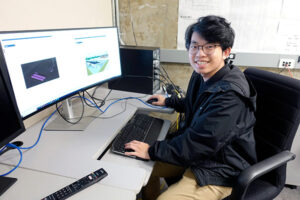
Marcus Fu is a third-year BCIT Electrical Engineering student working with the Smart Microgrid Applied Research Team (SMART) helping build digital twins and model energy systems. He first joined SMART last summer as a Co-op student and helped create a digital twin of the Energy OASIS project.
Energy OASIS
Constructed in 2012 and decommissioned in the summer of 2025, BCIT’s Energy OASIS (Open Access to Sustainable Intermittent Sources) project advanced microgrid technology, renewable energy integration, and electric vehicle (EV) charging infrastructure at a time when these systems were still in their early stages of development. OASIS was the first campus-based microgrid in Canada and one of the first in North America. Today, microgrids have been widely deployed, and many of the technologies piloted through OASIS have been implemented in real-world applications.
Building a digital twin for Energy OASIS
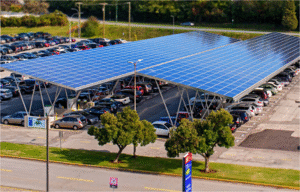
To preserve the research and the learning opportunities created by OASIS, SMART researchers, with Marcus’s help, have built a digital twin of the system. A digital twin is a detailed computer model of a real system. This virtual version of OASIS will allow students and industry explore how the system worked, test changes, and try out new ideas, even though the physical system has been taken down. It keeps the OASIS project “alive” as a safe, interactive place for students and industry to learn, experiment, and prepare for the real-world.
If you’re interested in electrical systems and working on applied research projects like this, check out BCIT’s Electrical Engineering program.

Hands on engineering experience
Working closely with Smart Microgrid Applied Research Team (SMART) researchers Minoo Shariat-Zadeh, Moein Manbachi, and Jay Nayak, Marcus has taken on a wide range of work that supports the Energy OASIS Digital Twin. He has helped build 3D models of the system, learned to use the Real Time Digital Simulator (RTDS), written programs that let real-time data move through the model, and created technical guides to help others understand the work. A key part of Marcus’s work also involves documenting and testing Industrial Control Systems (ICS) communication protocols, signals used in real energy systems. His work helps ensure the digital tTwin behaves like an actual power system, responding the same way real equipment would in the field.
In the coming months, Marcus will continue strengthening the digital twin by improving the 3D visualization tools and the backend software that powers them. He will also help develop clear documentation so future students and researchers can easily learn from and expand the project.
“Marcus has been an outstanding addition to our team. His work on the Digital Twin platform has accelerated our development timelines and significantly strengthened the technical foundation of our models, especially through his instrumental contributions to the Digital Twin of the Energy OASIS project” says SMART Project Leader, Dr. Moein Manbachi. “He approaches every challenge with curiosity, discipline, and professionalism, and his efforts have made a meaningful impact on SMART’s initiatives.”
“My experience on the SMART team is quite enjoyable,” says Marcus. “I’ve learnt a lot about new coding languages, digital systems, and industrial communication system protocols. Since I want to work in robotics, automation, or digital systems, this work has really helped me get closer to that goal.”
Through hands-on applied research projects that tackle real-world industry challenges, students sharpen their critical thinking, build advanced technical skills, and emerge as tomorrow’s problem solvers.
About SMART
The BCIT Smart Microgrid Applied Research Team (SMART) converges expertise in information technology, communications engineering, and energy management to develop advanced prototypes and solutions for complex applied research programs. At the forefront of its initiatives, SMART is advancing digital twin technologies for critical energy infrastructure, enabling real-time analysis, resilience testing, and intelligent decision-making. In parallel, the team leads R&D in OT cybersecurity, energy storage systems, and virtual power plant integration, addressing the evolving challenges of modern energy networks. Through strong collaborations with academia, industry, utilities, and government, SMART continues to strengthen BC’s innovation ecosystem and contribute to Canada’s energy transition.