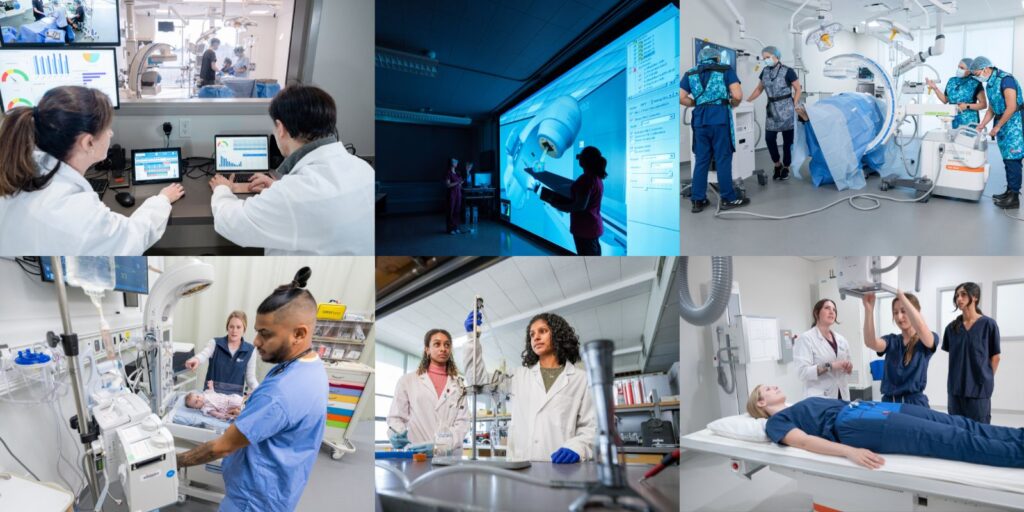
With an aging population and evolving healthcare needs, there is a growing demand for skilled professionals across the healthcare industry. With the Labour Market Outlook in BC predicting more than one million job openings over the next decade (2025–2035), the healthcare and social assistance industry is projected to generate the highest number of job openings in BC – with nearly 200,000 new job openings.
At BCIT, students can prepare for these in-demand jobs through hands-on learning that combines classroom theory with real-world experience. Here are 9 programs to help you get started.
1) Bachelor of Science in Nursing
The Bachelor of Science in Nursing is an accelerated program providing students with a nursing degree in three years, with the ability to take two specialty nursing theory courses during the program. Graduates gain experience working with industry professionals to prepare for a fast-paced, technical, and demanding work environment.
BCIT Nursing graduates are career ready due to a high number of clinical hours and preceptorship experiences. Upon completion of the program, students are eligible to write the National Council Licensure Examination (NCLEX) and have the skills to work in a variety of settings including hospitals and community health positions.
2) Medical Laboratory Science
Medical Laboratory Technologists (MLTs) perform critical laboratory tests that support physicians in diagnosing and treating patients. Their work is essential to delivering accurate diagnoses, guiding comprehensive treatment plans, and ensuring high-quality healthcare experiences. MLTs play a pivotal role in the healthcare system, performing 1.2 million lab tests in Canada every year.
The Medical Laboratory Science diploma is a 30-month program that includes a 35-week lab placement for hands-on experience in a workplace lab setting. With a combination of lectures and labs, students are prepared for careers in hospital and private laboratories.
3) Medical Radiography
Medical Radiographers work in hospitals and clinics providing positive patient experiences during imaging procedures. In a dynamic and fast-paced environment, students are trained in computed tomography (CT), fluoroscopy, OR imaging, emergency/trauma, interventional procedures, and mammography.
The Medical Radiography program is for students who enjoy working with technology, collaborating in teams, and interacting with patients. This full-time, 24-month diploma offers a combination of labs, lectures, and three clinical placements in hospital environments.
4) Bachelor of Environmental Public Health
The BCIT Bachelor of Environmental Public Health program trains students to become Environmental Public Health Professionals – also known as Environmental Health Officers (EHO) or Public Health Inspectors (PHI).
From major public events like the Olympics to everyday recreational spaces, EHOs play a critical role in ensuring the health and safety of communities. Their work includes performing routine inspections across a variety of facilities and investigating public complaints related to foodborne illness or pest control. Restaurants, public swimming pools, nail salons, community care facilities, and water supply and waste disposal systems are all areas where graduates work.
Many graduates secure employment opportunities with regional health authorities, Health Canada, Canadian Food Inspection Agency, provincial and federal public agencies, or private auditing and quality control companies.
5) Bachelor of Science in Radiation Therapy
Radiation Therapy is a one-of-a-kind, full-time, 33-month Bachelor of Science degree program. Radiation therapy uses targeted radiation to treat cancer. Students train to become Radiation Therapists, working with cutting-edge technology and gaining hands-on experience through labs and clinical placements at cancer centres.
Graduates are prepared to write the CAMRT national competency certification to begin their career as a Radiation Therapist.
6) Nuclear Medicine
Nuclear Medicine is an innovative field combining biology, radioactive material, and imaging to capture and control disease. This branch of medical imaging provides non-invasive diagnostic imaging to detect subtle changes in the body’s function and structure.
After a 24-month program with labs, lectures, and clinical experiences at nuclear medicine facilities in BC, students graduate with a diploma and are prepared for the CAMRT certification exam. Successful graduates are designated Registered Technologist Nuclear Medicine.
7) Magnetic Resonance Imaging
Magnetic Resonance Imaging (MRI) uses a high-powered magnetic field to form images that aid in diagnosis. MRIs help physicians assess organs, soft tissues, joints, the brain, and spine with exceptional clarity.
MRI Technologists are responsible for performing scans, ensuring patient safety, screening for contraindications, positioning patients accurately, selecting imaging protocols, and maintaining strict quality standards.
The full-time Magnetic Resonance Imaging diploma program includes 48 weeks of clinical practice in BC hospitals or clinics. Graduates are job-ready with the skills and competence to work in healthcare settings, such as hospitals, private clinics, and research facilities.
8) Honours in Biotechnology
The five-year, full-time Honours in Biotechnology program is a joint Bachelor of Science program that combines BCIT’s strength in providing practical, hands-on biotechnology training with UBC’s leading-edge biotechnology research and teaching. Students are equipped with both scientific and technical expertise and the business and communication skills to start their biotechnology careers as soon as they graduate.
Graduates earn both a Diploma of Biotechnology and an Honours Bachelor of Science in Biotechnology, preparing them for careers in research and pharmaceutical development.
9) Digital Health
The Digital Health Advanced Certificate is an exciting opportunity for healthcare professionals who are looking to expand their digital health expertise. The increased implementation of electronic health records and other technological advancements has created growing demand for professionals who can bridge clinical care and digital systems.
Delivered fully online through a flexible, part-time format, the program can be completed in as little as one year or spread over five years. This certificate prepares learners for informatics-focused roles by developing skills in integrating technology, evaluating clinical data, and navigating regulatory considerations in Canadian healthcare.
Thinking about healthcare? BCIT programs you can apply to right from grade 12.
Explore an in-demand career in healthcare
With the healthcare sector projected to lead job growth over the next decade, there has never been a better time to pursue a meaningful and in-demand career. If you’re ready to make a difference while building a strong future, explore BCIT Health Sciences programs and take the first step toward joining an in-demand workforce in BC.