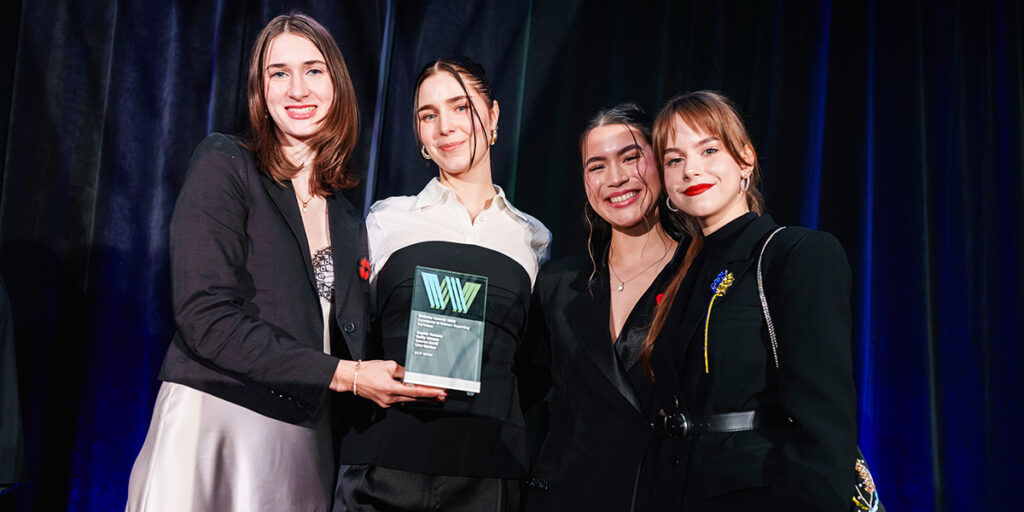
When Sophie Hansen, Emily Dineen, Lauren Accili, and Lisa Kovtun talk about their documentary, At What Cost? The Legacy of Florence Girard, they don’t begin with the Webster Award they won for their work. They begin with the responsibility they felt to the story and to the people who trusted them to tell it.
“It’s heartbreaking,” Emily says. “You think you understand what neglect looks like, but once you hear the family’s experience, it changes you.”
The documentary delves into the tragic story of Florence Girard, a woman with Down syndrome who died in 2018 after experiencing severe neglect while under care. It earned Excellence in Feature Reporting – TV/Video at the 2025 Webster Awards—one of Western Canada’s most respected annual celebrations of journalistic achievement, named after influential Canadian broadcaster Jack Webster.
Created while the team were students in BCIT’s Broadcast and Online Journalism program, the project demanded far more than technical skill. It required emotional endurance, determination, and the confidence to pursue a story that was heavy, complex, and deeply human.
Reporting with integrity and care
For Sophie, the story resonated immediately. Her younger sister is part of the disability community, shaping how she understood Florence’s case from the outset.
“Florence was an athlete, a sister, a bright light to a lot of people”, Sophie states. “We wanted people to understand who she was and why her story matters.”
The team began working on the documentary as the coroner’s inquest concluded, making the reporting both timely and complex. Legal findings, systemic accountability, and grief all intersected in the story. Emily’s personal connection helped establish trust with Florence’s sister Sharon, and provided an access point which the group treated with care.
Once that trust was established, the responsibility deepened. Accuracy, fairness, and respect guided every editorial decision. BCIT’s training shaped how they approached that responsibility. Media law courses, ethical discussions, and faculty input helped ensure the team handled the story with integrity.
“As a faculty, we are incredibly proud of this team for taking on such a difficult but important project”, says Christine German, Program Head in Broadcast and Online Journalism. “They completed the documentary as part of their final capstone project in the program, bringing together all of the training they had received to that point. They worked alongside faculty mentors, but full credit to them for pursuing a story of incredible community significance that also had strong personal connection for them.”
Recognition that fuelled creative confidence
For several team members, the recognition they received during their time at BCIT reinforced the confidence to take on such a demanding project. Awards funded by generous donors didn’t just celebrate their achievements. They gave these young journalists the confidence they needed to pursue an emotionally demanding project.
Sophie, who received the Stowe School Award, the Rotary Club of Burnaby Foundation Award, and the Jim Robson Graduate Achievement Award, says those honours came at a critical time.
“As a young woman in journalism, those awards made me feel like someone was rooting for me,” she says. “They gave me confidence and the financial support took pressure off so I could focus fully on school and being a journalist.”
That focus mattered. The story required in-depth reporting, emotional resilience, and time. Something student journalists don’t always have.
Lauren, who had received the OMNI Television Award in Broadcast Journalism for her story highlighting women in aviation and trades, says that recognition helped her trust her instincts as the documentary’s lead video editor.
“When you’ve been told your work has value, you’re more willing to stand by creative choices,” Lauren says. “This story required us to take risks and go beyond to make it something great.”
Trusting creative instincts
Lauren knew from the beginning the documentary couldn’t feel like a standard news segment.
“This story deserved more than just informing people,” she says. “I wanted to make people feel the way I felt when I discovered Florence’s story.”
One of the most striking creative decisions was the opening black screen with only audio. It was a risk that sparked debate.
“People told me not to do it,” Lauren recalls. “But if I had played it safe, this documentary wouldn’t be what it is.”
That willingness to push creatively was reinforced by a program that challenges students to justify their decisions rather than abandon them. It was also strengthened by working alongside other women who trusted one another’s judgment.
Empathy, support, and strength
For Lisa, that trust was especially meaningful. At 17, she arrived in Canada from Ukraine and enrolled in BCIT shortly after high school, navigating a new country, language, and industry at once. Receiving the Michael Thurston High Flight Memorial Award, which is awarded to journalism students who have left home to pursue their education, affirmed that she belonged and that others believed in her potential.
“As a woman starting over in a new country, it meant so much for myself and for the little girl who came here,” Lisa says. “That recognition showed me I was doing something right, and it motivated me to work harder.”
That affirmation carried directly into her role as the documentary’s lead camera operator, responsible for framing, lighting, and visual consistency. Though roles were assigned, the team worked collaboratively across every stage of production.
“We did everything together,” Lisa says. “Researching, filming, editing—we were a team.”
Teamwork was essential as the production schedule became more demanding. While interning together at CBC in Toronto, the team lived and worked alongside one another, developing the documentary remotely before returning to BCIT for an intense final edit. Days stretched into nights as they exported cut after cut, screened it, spotted flaws, and refined their work again.
“We watched it over and over,” Lauren recalls. “Every tiny detail mattered.”
The emotional weight of the story was just as heavy, deepening the bond among them. Interviewing Florence’s family stayed with all four of them long after filming wrapped.
“There were times when we checked in on each other just to make sure everyone was okay,” Sophie says. “That weight reminded us why the responsibility mattered.”
From students to award-winners
That shared responsibility and shared support carried through to the Webster Awards. When their category was announced as the final award of the evening, none of them expected to win.
“We were up against professionals,” Lauren says. “I thought it was great just to be nominated.”
When their names were called, disbelief turned into emotion. The win marked a historic moment as the first student group to receive a Webster Award in a professional category.
For the team, the recognition wasn’t about prestige. It was about affirmation that despite age and gender, meaningful work gets noticed even when the work is trying.
“As a woman being recognised in an industry that at one time was very dominated by men, it’s a wonderful thing,” Sophie remarks. “Showing other young women and journalists in the industry that even though we’re young women, it doesn’t mean success isn’t impossible.”
A shared legacy
Today, the four alumni have taken different paths working in reporting, production, and community advocacy, but At What Cost? The Legacy of Florence Girard remains a shared milestone.
“It reminded me why I wanted to be a journalist,” Sophie says. “To tell stories that demand change.”
For Emily, the documentary and the recognition surrounding it marked a defining moment in her career growth.
“It made me see myself as capable,” she says. “Like I earned my place.”
“This wasn’t easy,” adds Lisa, “but it showed me that if you stay true to the story, the work will carry you forward.”
Together, their experience reflects the strength of BCIT’s hands-on journalism education which equip students with technical expertise, ethical grounding, and the confidence to trust their voices. Through intensive, real-world reporting opportunities, and recognition that reinforces their potential, the program prepares graduates to take on complex stories with professionalism.
As alumni now working across media and advocacy, their Webster Award stands not only as a milestone, but as proof that when students in media are supported, challenged, and trusted, they are capable of producing journalism that informs, moves, and makes a lasting impact.
To learn more about how you can create a student award to support future changemakers like Emily, Sophie, Lauren and Lisa visit bcit.ca/foundation