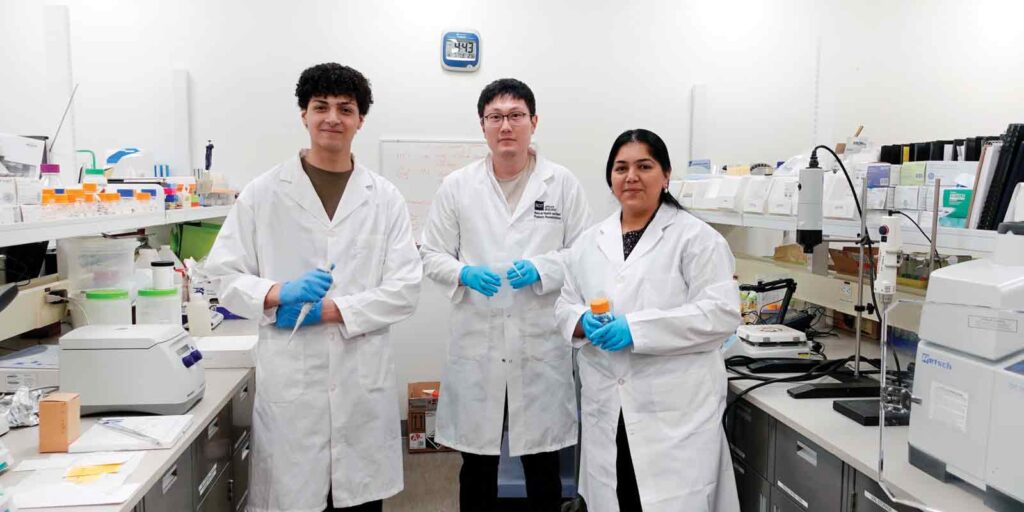
BCIT student researcher Ziad Kandeel is advancing sustainable approaches to health and nutrition by helping transform seafood waste into valuable, high-impact health solutions.
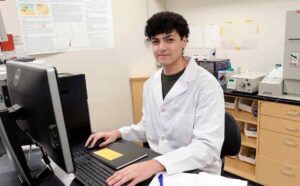
Ziad is a second-year student in the UBC/BCIT Joint Honours in Biotechnology program working with BCIT’s Natural Health and Food Products Research Group (NRG) as a part-time student researcher. He is part of Dr. Anika Singh’s research program, and works closely with research assistant Dr. Yigong Guo. Ziad contributes to Dr. Singh’s NSERC Discovery Grant research, which focuses on improving the bioavailability of fat-soluble nutrients.
Ziad’s work focuses on how omega-3 fatty acids taken from seafood byproducts like salmon can be more easily absorbed by the body. Currently, when people consume omega-3s or other fat-soluble nutrients, a significant portion is not fully absorbed or used by the body. Omega-3s can be unstable, are often digested inefficiently, and have low bioavailability, all of which limit their potential health benefits. Ziad is helping develop tiny delivery packages called lipid nanoparticles (LNPs), that protect omega-3 nutrients and help the body absorb them more effectively. His work supports Dr. Singh’s broader research program aimed at making these nutrients more stable, easier for the body to absorb, and more effective in food and health applications.
Through this hands-on experience, Ziad is developing key technical and problem-solving skills while contributing to active, nationally funded research. “My work at NRG under the supervision of Dr. Anika Singh, with day-to-day mentorship from Dr. Yigong Guo has provided me with unique exposure to lipid nanoparticle technology, which I have found genuinely fascinating because of how promising and versatile it is,” says Ziad. “Working on this project has helped me develop skills closely tied to effective LNP development, while honing crucial research skills such as problem-solving and communicating scientific ideas. Overall, this experience has made me want to focus my future education and career on research involving LNPs and related nanoencapsulation technologies.”
Project supervisors have been very impressed. “Ziad has demonstrated strong dedication and consistency in his work,” says Dr. Guo. “In particular, he is proactive in problem-solving and shows independence in conducting experiments and analyzing results. His contributions have helped accelerate the progress of our project, and his findings provide meaningful insights that support the overall research objectives. With continued development, Ziad’s work has clear potential for academic publication.”
For Ziad, this experience with NRG has taken him beyond the classroom to tackle real-world challenges, contribute to funded research, and gain the confidence to work independently in a professional research environment.
Student-applied research projects like these educate tomorrow’s problem solvers and provide hands-on, real-life problem-solving experiences, preparing students for successful careers through experiential learning.
About BCIT Natural Health and Food Products Research Group (NRG)
BCIT Natural Health and Food Products Research Group (NRG) addresses issues of product quality, process improvement, and human health using basic and applied science along with state-of-the-art technology. The goal of NRG is to ensure that all Canadians can achieve the potential health and economic benefits offered by medicinal plants, natural health products and the food industry.