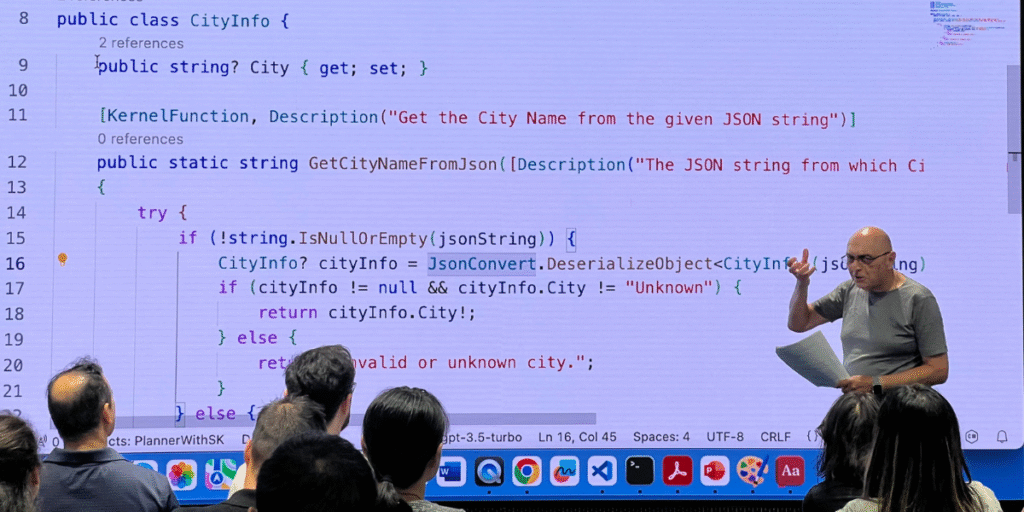
Artificial intelligence (AI) is reshaping software development, and Computing instructor Medhat Elmasry wants his students to be ready for it. With more than 25 years of experience teaching coding and web development, he now integrates AI tools into his courses – helping Computer Systems Technology (CST) Diploma students understand how to use AI responsibly and stay competitive in a rapidly changing tech field.
There are a few spots left to start CST in January!
“I know many graduates personally,” Medhat says, “and they tell me that these days, if you want to get a job, AI has to be part of what you do.”
Medhat sometimes sees resistance from people who warn developers not to use AI in their coding. But to him, that’s like telling someone not to use Google. “You can’t stop anybody from doing it,” he says. “AI is the future. I’m not going to go against it because I can’t change it.”
From BCIT student to BCIT instructor
Medhat’s relationship with BCIT goes back decades. After immigrating to Canada from Egypt, he immediately enrolled in BCIT Computing part-time courses to strengthen his skills. Many of those early courses were taught by longtime instructor Jim Parry, who later encouraged him to teach. Program Head Computing Flexible Learning, Kevin Cudihee, eventually offered him his first part-time teaching position.
Today, Medhat is the CST Option Head for Web & Mobile (.NET), a path that focuses heavily on programming. Because of that, he has made it a priority to integrate AI into courses like COMP 4952 and COMP 4976.
“AI is becoming very smart,” he says. “Linus Torvalds’ code – the man who invented Linux – is online. AI models are trained on enormous amounts of high-quality code, so it does a really good job coding.”
The danger of vibe coding
But Medhat is equally clear about the risks. He frequently sees students fall into what is called vibe coding: pasting vague instructions into a model, copying the output, and hoping it works. It’s a habit that results in what he calls “spaghetti code”.
“The AI code can often lack consistency and create a lot of duplicates,” says Medhat. “You have to be careful because it becomes totally unmaintainable.”
“AI can help you, but it can’t replace knowing what you’re doing.”
He worries that non-developers will use AI to generate entire applications they don’t understand. “It’s software that appears to work, but then quickly becomes impossible to manage and to keep secure. Eventually, the AI-generated code will break at some point.”
Medhat is intentional about the kind of AI he focuses on. He doesn’t teach Machine Learning – several other faculty members specialize in that. His focus is on helping students use existing large language models (LLMs), such as GPT-5, to make their applications smarter.
The USB of AI
One of the most powerful ways he teaches this is through the Model Context Protocol (MCP), which he describes as “an incredible revolution in the way you use AI.”
“MCP is the USB of AI,” Medhat explains. “A USB lets you plug in anything – a keyboard, a camera, a hard drive – and your computer instantly knows how to talk to it. MCP does the same thing for AI models. It gives them a universal way for LLMs to connect to tools, apps, and live data.”
Before MCP, AI relied on the data it was trained on. With MCP, it can request real-time information.
For example, in his labs, Medhat shows students how to use MCP to let an AI model pull the live transcript of a YouTube video. Instead of relying on outdated training data, the model sends a request in real time, retrieves the transcript, and turns it into a different spoken language or a summary.
AI raises the bar

“The reaction has been overwhelmingly positive,” says Medhat. “Students feel they are learning something new and practical, and they appreciate seeing how AI connects to the work they’ll do as developers.”
Although AI can make certain tasks easier, Medhat stresses that this doesn’t mean expectations should drop. If anything, the bar is rising for software development professionals.
“We are in a new era,” he says. “Much more is expected.”
He contrasts today’s environment with his own student experience. “When I studied, there wasn’t even internet, let alone AI. We were doing everything ourselves. Now that we’re in a new era, and students have AI as a companion, I’m holding them to a higher standard.”
Staying at the cutting edge with Microsoft MVP work
One reason Medhat stays ahead of emerging technologies is his role as a Microsoft Most Valuable Professional (MVP), an award he has held for eight years. Maintaining MVP status requires him to regularly share knowledge through talks, blogs, videos, and community events. In return, he gains early access to new tools and credits to experiment with.
“When new technology comes out, I read about it, they tell me about it, and I try it out,” he says. “AI is evolving at an unprecedented pace, with new frameworks and libraries emerging almost daily. This rapid innovation creates an exciting yet demanding experimental phase, where developers must navigate challenges and adapt quickly to stay ahead.”
Student assessment: back to the Stone Age
But even with all the opportunities AI brings, one major hurdle persists: how to accurately assess students.
Across post-secondary institutions, instructors grapple with the same dilemma: when AI can generate high-quality code, essays, or analyses in seconds, how do you distinguish genuine understanding from automated output?
“Before this year, my exams were done on a laptop, but now I can’t do that anymore,” Medhat explains, “because the students can now produce code without necessarily understanding its structure and logic.”
As a result, he has returned to pen-and-paper exams.
“We went back to the Stone Age,” Medhat laughs, “but there’s no other way. The onus is on the student to understand the material; otherwise, they’ll fail the midterm and final exam.”
For Medhat, real learning happens when students can both leverage new technologies and stand on their own when needed.
“It’s simple,” he says. “AI can help you, but it can’t replace knowing what you’re doing.”