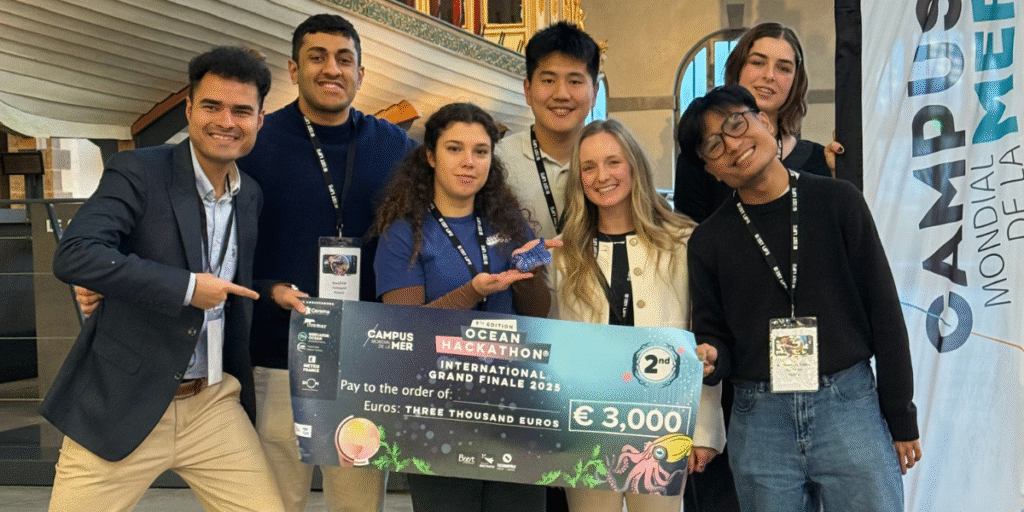
When Computer Systems Technology (CST) Diploma student Dom Torres (on the right in the photo above) joined a local hackathon in Victoria last fall, he was looking for a chance to work with real-world data. Six weeks later, he found himself presenting an AI-powered ocean analytics project on an international stage in France – and earning a spot on the podium.
“CST teaches you to pick things up very quickly, keep experimenting and not get blocked.”
For Dom, the appeal of hackathons has always been simple: they offer a rare opportunity to step outside the classroom and test technical skills against real-world problems. That motivation led the CST student to sign up for OceanHacks, a 48-hour hackathon held in Victoria in October and hosted by Canada’s Centre for Ocean Applied Sustainable Technology (COAST).
“I was definitely excited,” Dom says. “The chance to work with real data, which is most of the time messy and unordered, and try to make sense of it, really appeals to me.”
Tackling a complex ocean data challenge
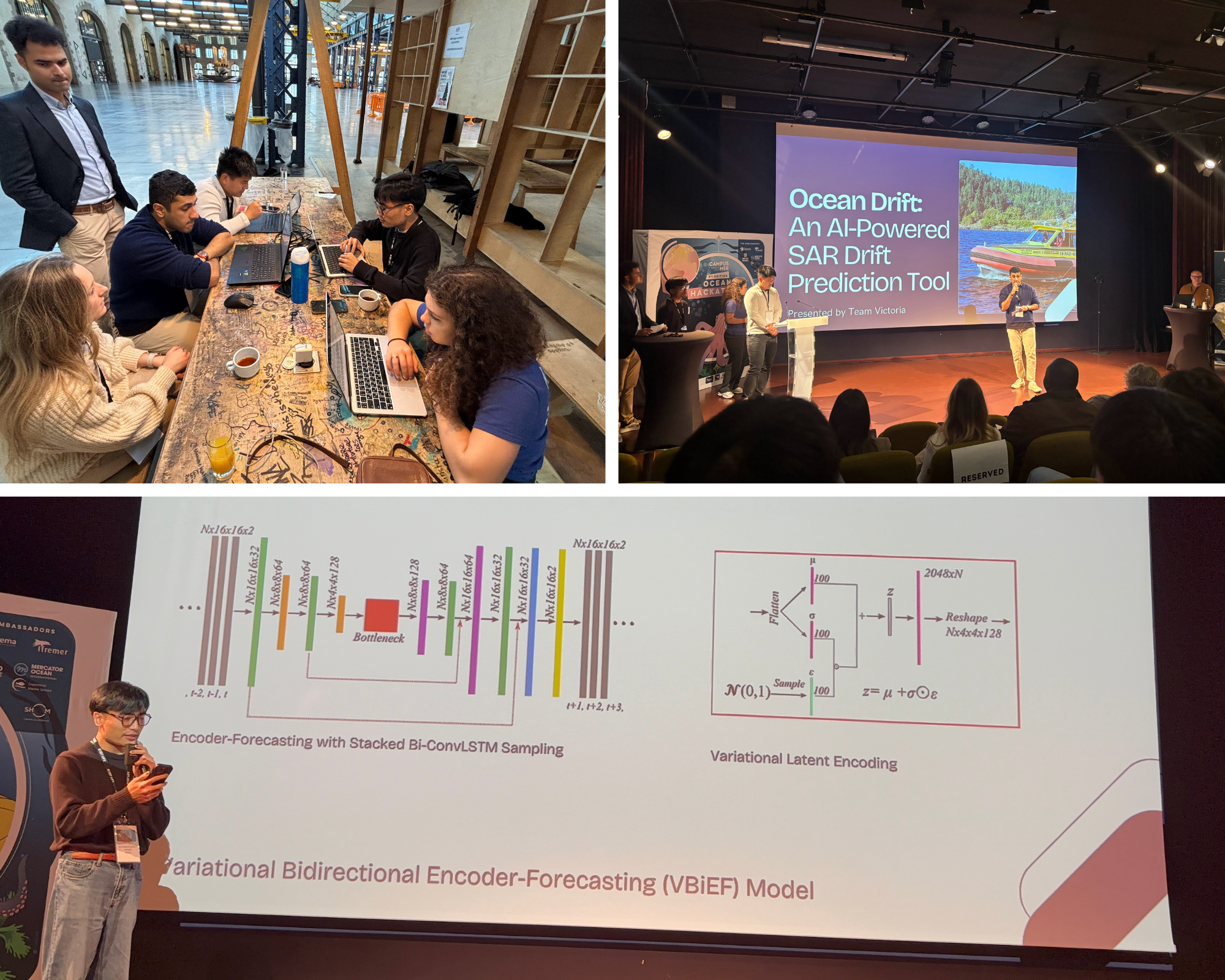
The challenge focused on understanding why ocean currents in the Strait of Georgia move the way they do. Using real-world data from Ocean Networks Canada (ONC), the team studied whether tides, wind, or river runoff has the biggest impact on how surface waters shift and change.
Dom was part of a five-person team with students from BCIT, University of British Columbia, Northeastern University, and the University of Victoria, each bringing different technical and academic backgrounds to the table. While Dom contributed data science and machine learning expertise, other team members brought experience in oceanography, app development, and software engineering.
The interdisciplinary nature of the challenge proved to be one of the biggest hurdles.
Learning across disciplines
“Even just from an oceanography lens, trying to characterize or predict surface currents isn’t a 100 percent solved problem,” Dom explains. “As someone with no ocean science background, it was difficult to wrap my head around the physics and integrate that with a data science approach.”
That difficulty, he says, reinforced the importance of collaboration.
“You have to trust your team,” Dom says. “You can’t know it all. Tackling a problem like this requires listening to people with different expertise.”
From experiment to real-world impact
The team’s solution – named Ocean Drift – uses artificial intelligence and deep learning techniques to analyze these complex surface current patterns. While initially framed as an exploratory data challenge, the group quickly realized their work could have practical applications.
“We saw that this could be applied to search-and-rescue operations and ocean forecasting,” Dom says.
Taking the experience global
That insight helped the team stand out at the Victoria event, where they placed first and earned an invitation to the Ocean Hackathon 9 finale in Brest, France, in early December. The global competition brought together ten finalist teams from coastal cities around the world, all presenting data-driven solutions related to ocean science, sustainability, and management.
For Dom, the transition from a regional hackathon to an international stage was both intense and rewarding.
“CST teaches you to pick things up very quickly, keep experimenting and not get blocked,” he says. “It’s stressful, but ideal in a pressure-filled and time-constrained setting like a hackathon.”
Dom also credits instructor Pat McGee and the Predictive Analytics option with strengthening his foundation in data exploration and iterative problem-solving.
Creating lasting memories
During the grand finale, Dom and his team presented Ocean Drift to an international jury, ultimately earning second place and a €3,000 prize. They were the only North American team to reach the final round.
Beyond the technical achievement, Dom says the international experience left a lasting impression.
“What stood out to me was how much data is out there, across industries, that’s just waiting to be explored,” he says. “But more broadly, it’s about connecting the right people and working across disciplines. This is where I’m also grateful to CST for emphasizing the importance of working with teams very early on. You have to learn how to listen because you can’t know it all.”
Interested in Computing? Join us for one of the upcoming (online) Info sessions.