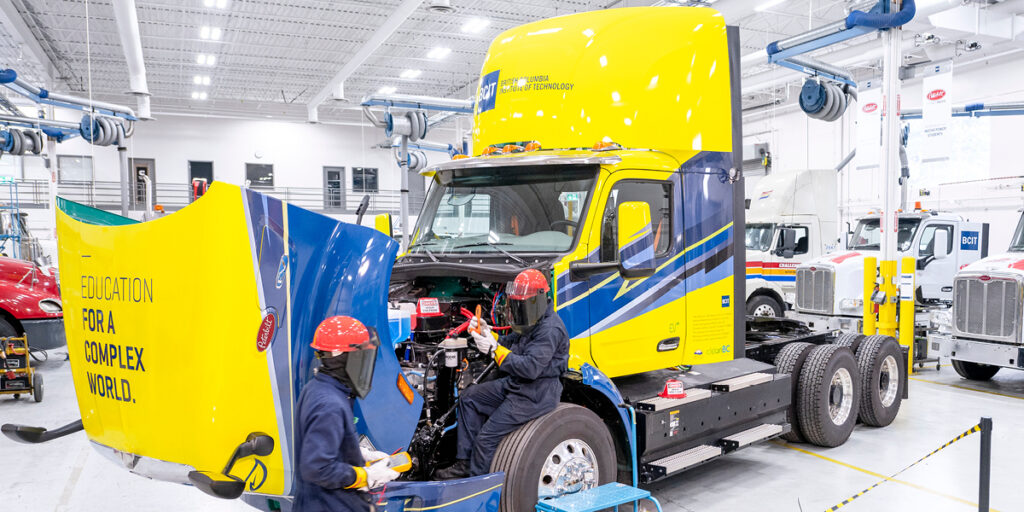
A jewel on the shop floor, BCIT’s new fully electric Class 8 Peterbilt truck glistens with opportunity. As BC’s Zero-Emission Vehicle (ZEV) mandate leads the shift to cleaner transportation, more commercial fleets are turning to electric and hydrogen-powered trucks—creating new opportunities for technicians trained in next-generation technologies.
BCIT gratefully acknowledges the financial support of the Province of British Columbia through the Ministry of Energy and Climate Solutions. With this support, the Heavy Duty Truck Technology (HDTT) diploma gives students hands-on ZEV training using advanced equipment like the electric Peterbilt truck. The program prepares students to lead the way for the future of clean, heavy-duty transportation.
Start your journey in transportation trades. Sign up for an info session.
Real-world EV heavy-duty equipment training
With the latest tech like the EV Peterbilt, students get their hands on full-size, commercial, ZEV equipment. They work in a controlled, educational environment with expert guidance. This allows them to safely learn how to diagnose, service, and repair these systems. “There can be upwards of 30 computers on a truck, and they all talk to each other,” says Steve Grone, BCIT Truck and Transport Mechanic Instructor. Students will learn advanced diagnostics on cutting edge training tools. “Our students learn how to build systems, test them, and then apply that knowledge directly on real trucks in the shop.”
Along with hands-on experience students also work towards professional certification. Their coursework is closely aligned with the outcomes of the Canadian Standards Association (CSA) Heavy Duty EV certification exam preparing students to meet national industry standards. This partnership reflects BCIT’s commitment to safe, high-quality EV training—aligning classroom learning with real-world industry standards.
BCIT and CSA: Shaping the future of safe EV work
Safety is key when it comes to emerging EV technology. That’s why, as Bruce Thompson, Interim Dean, BCIT School of Transportation explains, “we have a close relationship with CSA.”
With the growing need for standardized safety protocols in the EV sector, BCIT and CSA collaborated to develop a federally recognized certification program. This ensures that technicians are trained to meet rigorous Canadian safety standards when working with high-voltage EV systems.
“Through our collaboration with CSA, BCIT has helped advance national safety standards for EV training in both the automotive and heavy-duty vehicle sectors. Why? Because industry wants people who are ready to work safely, and certification matters,” Bruce adds.
Level up your EV skills with a BCIT Flexible Learning course.
Skills for a trades career with a green future
More than just hands-on training, the BCIT HDTT diploma is a launchpad to a lasting career. As Steve Grone states, “If you want to turn your passion for machines into a career that’s in demand, this diploma is a good place to start.” For those ready to work with their hands, solve complex problems, and be part of BC’s clean energy transition the heavy-duty technician trade offers a meaningful career path. And, with more than 2,400 heavy-duty equipment mechanics job openings expected in BC over the next decade, the Heavy Duty Truck Technology diploma is a smart step toward launching an in-demand career.
(Some sections of this article were refined using ChatGPT. Quotes are provided by BCIT community members. Editing, fact-checking, and final approval by Mirabelle Rohatgi on November 24, 2025.)