
What happens when we begin to surrender aspects of our thinking, judgment, and decision-making to AI?
This is one of the topics that intrigues Erika Ram, BCIT Computing faculty, as AI becomes increasingly integrated into higher education. Erika is also the Chair of BCIT’s Educational Technology and Learning Design Committee, as well as lead for the BCIT Education Plan initiative focused on fostering a culture of academic integrity. Here’s what she had to tell us about the evolving teaching, learning, and assessment landscape.
“One of the biggest challenges is finding the right balance between embracing what AI can do and preserving the learning experiences students need to develop their own expertise.” – Erika Ram
Q: What can you tell us about your work in educational technology adoption?
Erika Ram (ER): Much of my work focuses on how we can thoughtfully integrate technology into education practices.
Over the past few years, artificial intelligence has become an increasingly big part of that. I’ve been involved in initiatives related to AI literacy, educational technology governance, academic integrity, and supporting faculty and staff as they navigate new technologies in their classrooms.
What I tend to find most interesting isn’t necessarily just the technology, but how it changes the way we teach, learn, and work. As AI becomes more capable, I think we need to be increasingly intentional about the skills we help foster and the experiences we provide to students. More specifically, I mean the skills and experiences that help students differentiate themselves, bring value to the workforce, and develop their human-centred skills like critical thinking, metacognitive, self-regulation, self-motivation, and authenticity.
Q: What are the most significant challenges of AI in education?
ER: One of the biggest challenges is finding the right balance between embracing what AI can do and preserving the learning experiences students need to develop their own expertise. AI can bring out a lot of polarizing views, especially in teaching and learning.
AI can be an incredibly useful tool for brainstorming, explaining difficult concepts, providing feedback, and supporting problem-solving. But those same capabilities can also make it easier for students to bypass important parts of the learning process.
At the recent AI-cademy 2026 Conference, I spoke in a plenary discussion about “Cognitive Surrender”, the impacts of deferring our thinking and judgment to AI rather than merely using it to support our own reasoning.
I think the challenge for educators is that the answer isn’t simply to encourage or restrict AI use. We need to consider the purpose of an activity, the student’s level of expertise, and which parts of the thinking process are essential to learning.
Sometimes making a task easier supports learning. Other times, the struggle is where the learning happens. The challenge is recognizing the difference and embedding them into our teaching and learning so that students can recognize it too.
Q: Where can this work take us?
ER: I hope it helps us move beyond the question of whether students should use AI, and toward more meaningful conversations about how we prepare students to learn, think, and work effectively alongside it.
One area I’m particularly interested in is applying self-regulated learning theory to AI use: helping students develop the ability to plan their approach, monitor their understanding, evaluate their decisions, and reflect on their progress.
These skills have always been important, but I think they’re becoming even more valuable in an environment where AI can generate convincing answers almost instantly.
By designing learning experiences that encourage students to question, verify, revise, collaborate, and reflect, we can help them develop both AI literacy and the confidence to exercise their own judgment.
Ultimately, I hope this translates into students who aren’t just capable of using new technologies, but who can adapt to change, recognize their limitations, and take ownership of their learning and work.
“As educators, we’re not just preparing students to use AI. We’re preparing them to work alongside it and develop the qualities that make them valuable colleagues, problem-solvers, and professionals.” – Erika Ram
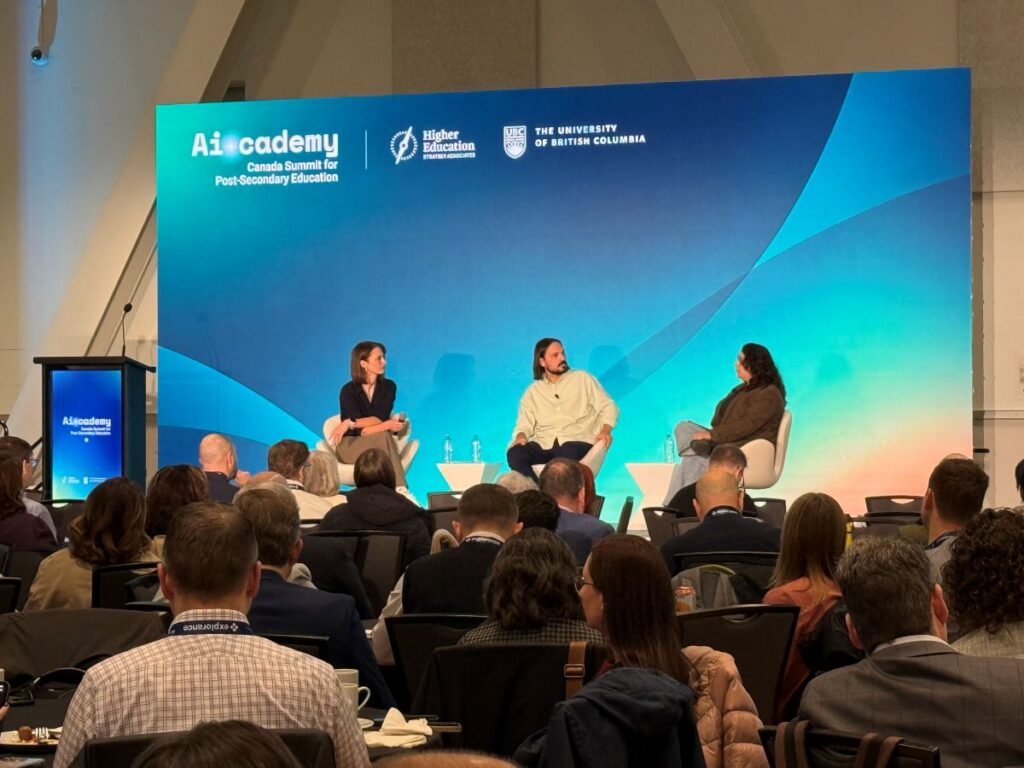
Q: What were some of the key ideas that stood out to you at AI-cademy 2026, and how do they connect with your work at BCIT?
ER: One of themes that kept coming up that I found especially relevant is the relationship between AI, human judgment, and the learning process.
Both during my plenary discussion, and pre-conference presentation Human-centred Skills in an AI-Influenced World, a question I keep coming back to is: when does using AI to support our thinking become allowing AI to do our thinking for us?
This connects closely to conversations we’re having at BCIT about AI literacy, assessment design, and academic integrity.
One concept that came up a lot during the conference was “productive friction”: the idea that some of the effort, uncertainty, and challenges involved in learning are necessary for developing expertise. The goal isn’t to eliminate that friction, but to design learning experiences that provide appropriate support while gradually helping students become more capable and independent.
Another theme echoed throughout the conference was the importance of focusing not just on what students produce, but the process of how they get there. This means designing activities and assessments that make students’ thinking visible, encourage them to explain their decisions, reflect on their learning, and demonstrate how they’ve applied their knowledge. With AI increasingly capable of producing polished final products, understanding the process behind the work becomes even more important.
What I appreciated about the conference was the opportunity to engage with different perspectives on these challenges and think about how emerging research can inform practical approaches in our classrooms.
Q: What kinds of skills are most needed in today’s workplace?
ER: At the beginning of each term, I ask my students to think about someone they really enjoy working with and what qualities and skills that person has. When I do workshops on human-centred skills with teachers I ask the same thing.
Across both groups, their answers usually have very little to do with a specific technical proficiency. Instead, they talk about people who communicate well, collaborate, are passionate, take feedback, adapt to challenges, and are willing to learn.
I think that’s particularly important as AI changes the nature of how we work.
Technical skills will continue to matter, but organizations will also need people who can think critically, exercise judgment, communicate effectively, and work collaboratively to solve complex problems.
AI can help us accomplish many tasks more efficiently, but knowing which questions to ask, evaluating the quality of information, making responsible decisions, and navigating relationships remain incredibly important.
As educators, we’re not just preparing students to use AI. We’re preparing them to work alongside it and develop the qualities that make them valuable colleagues, problem-solvers, and professionals.
Q: What’s next for your work in supporting student learning?
ER: For me, the next step is continuing to take these conversations and emerging research and translate them into practical approaches that educators and students can use.
At BCIT, I’m involved in work related to AI literacy, educational technology, and an institutional initiative focused on strengthening academic integrity.
I see a lot of connections between these areas. Many of the strategies that support academic integrity, such as authentic assessment, reflection, clear expectations, and student ownership of learning, can also help address some of the concerns around cognitive surrender.
I’m particularly interested in helping instructors consider where AI can genuinely enhance learning, where students need opportunities to work independently, and how we can scaffold those experiences as students develop expertise.
I also want to continue learning from other colleagues, researchers, and students. AI is evolving quickly, and I don’t think there’s a single solution or approach that will work across every discipline or learning environment.
What matters is continuing to ask thoughtful questions, evaluating our approaches, and keeping student learning at the centre of our decisions.
Sign up for our quarterly Tech It Out and keep up with the latest from BCIT Computing.