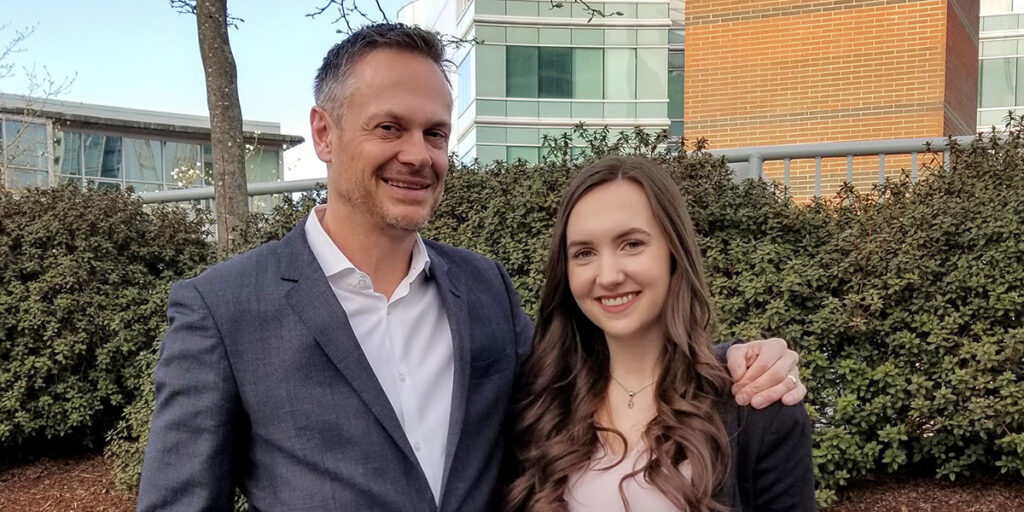
When Mark Hermans graduated from BCIT in 1989, the program was rooted in Vancouver’s strong manufacturing economy. Years later, his daughter Brooklyn completed the program in 2020, entering a workforce defined by digital systems, global supply chains, and rapidly evolving technology.
Across three decades of change, one thing remained constant: BCIT’s Operations Management program, housed within the School of Business + Media, prepared them both for lasting career success.
Proven longevity, enduring fundamentals
Mark enrolled after finding traditional university studies were not the right fit. He was looking for something practical, immersive, and connected to real careers. What he found was an intense, highly structured program that demanded commitment. Starting with nearly 70 students, fewer than half graduated. The rigour and volume of coursework of nine or 10 classes per term, required focus, resilience, and teamwork.
“It prepared me to handle a lot at once,” Mark states. “That ability stayed with me my entire career.”
While the program has evolved in name and scope over 50 years, its foundation remains strong. Core courses in accounting, economics, communications, project management, and production and inventory management. Over time, the focus shifted from traditional manufacturing toward services, systems, and enterprise resource planning (ERP), reflecting broader economic change.
“The fundamentals stayed the same,” Mark explains. “The applications evolved with industry.”
Applied learning that translates to leadership
Both Mark and Brooklyn now work in consulting and systems implementation, careers that require analytical thinking and operational insight.
For Mark, the program’s blend of business and technical training shaped a decades-long career in technology implementation for manufacturing and service organizations. He frequently drew upon principles learned at BCIT, from inventory management formulas to process design frameworks. Just as important was learning how to manage competing priorities and make sound decisions under pressure.
Brooklyn experienced that same applied approach through industry-sponsored projects, where students worked directly with companies to solve operational challenges. Those projects mirrored the consulting environment she entered after graduation.
“Project management, accounting, and working in teams are things I use all the time,” she says. “It felt very relevant to the workplace.”
This hands-on model reflects BCIT’s mission to provide education that prepares graduates not just to understand theory, but to lead operations, improve processes, and solve real-world problems from day one.
Industry-connected and future-focused
The program’s continued relevance is reinforced through regular industry input. Mark recently participated in a program review, providing feedback on curriculum alignment with workforce needs. Faculty members with industry experience and ongoing curriculum updates help ensure graduates remain competitive in a changing economy.
“It’s built to prepare you for a job,” Mark says. “That’s always been clear.”
Term projects, team-based learning, and close collaboration remain central components of the program. Both graduates credit these experiences with building confidence and professional readiness.
A lasting impact beyond the classroom
The long-term success of graduates is one of the program’s strongest indicators of its impact. For the Hermans family, Operations Management represents more than career preparation. It is a shared experience that spans generations.
Mark retired at the end of 2025 after serving as President of a large technology consulting services business unit. His career focused on helping organizations implement systems and improve operations which reflects the type of leadership roles the program prepares graduates to pursue. While stepping back from full-time leadership, he plans to continue supporting organizations on a selective, part-time basis. He also hopes to return to BCIT as an instructor, sharing his industry experience with the next generation of students.
Brooklyn represents the next generation of Operations Management graduates. Through conversations with her father about how the principles he learned at BCIT shaped his career, she sees firsthand how the program’s lessons continue to guide real-world decision-making long after graduation and appreciates having an “in-built mentor” who understands the realities of operations and leadership.
Their story illustrates the broader impact of a BCIT education. Graduates leave with practical skills and industry credibility, as well as confidence, resilience, and pride in having completed a demanding program. Five decades after its launch, Operations Management continues to demonstrate that rigorous, applied education creates success that stands the test of time.
For more information about the Operations Management program, register to attend the 50-year Anniversary Showcase on April 9 or an online information session on April 16.