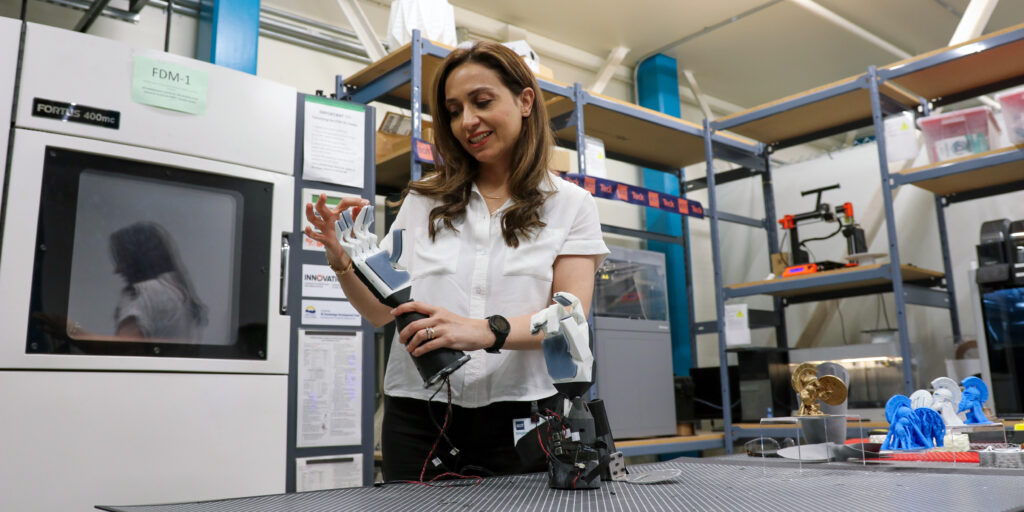
A 3D-printed part can look perfect but still fail under the demands of everyday use.
That’s a particular concern when developing products people rely on, including prosthetic devices. Even seemingly simple components need to withstand the wear and tear of regular use.
For MAKE+ Research Associate Shadi Sabeti, understanding how and why these components fail is an important part of her work. Drawing on her background in Materials and Biomedical Engineering, Shadi develops and tests 3D-printed components and prosthetic technologies to help make them more durable and reliable.
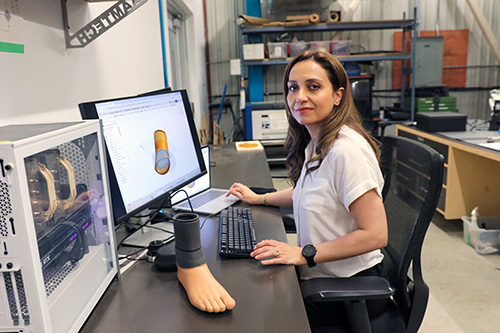
What is your role with MAKE+?
I’m a Research Associate at the BCIT Centre for Applied Research and Innovation (CARI). For the past five years, I’ve worked with the MAKE+ applied research group within the Advanced Additive Manufacturing Technology Hub (AAMTECH), focusing on additive manufacturing, materials research, and prototyping. My role lets me combine my background in materials and biomedical engineering with hands-on applied research.
What inspired you to pursue applied research?
The chance to take an idea or a real-world problem and work toward a practical solution. I also really enjoy the iterative nature of applied research. You can design something, build it, test it, learn from what didn’t work, and improve it. Seeing that process eventually lead to something that can be used is very satisfying.
Applied research is also highly interdisciplinary, and I get to collaborate with people from different areas of expertise. I really value the opportunity to learn from others and bring different perspectives together to solve a problem.
What kinds of projects does MAKE+ work on?
MAKE+ is a multidisciplinary applied research group that works with industry, healthcare, and other partners on product and process development, evaluation, and applied research. Our projects range from early-stage product development and prototyping to testing, verification, and validation. We work across areas such as health and assistive technologies, consumer and industrial products, advanced manufacturing, and electronics.
Our ISO 13485 certification is particularly important for our work on medical and assistive devices, allowing us to support their development and evaluation within a quality management framework.
What is a recent project you’re proud of?
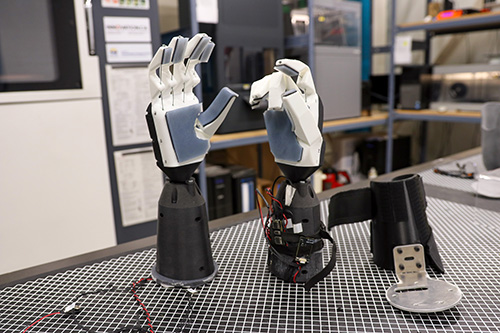
One project I’m particularly proud of is the Soft Hand project, where our team developed a single-actuator soft robotic prosthetic hand. The project involved combining 3D-printed components, flexible materials, silicone elements, and electronics to create a functional, affordable prosthetic concept.
For me, the most meaningful aspect of the project is its potential to make prosthetic technology more accessible and adaptable for people who need it. It also gives students the opportunity to work on a real-world challenge and see how engineering can directly address a community need.
Applied research is about solving real-world challenges. What challenge are you tackling right now?
One challenge we’re currently working on is improving the durability and performance of 3D-printed prosthetic covers. These components need to withstand repeated loading during everyday use, so we’re looking at different designs, materials, and printing parameters, and testing them under cyclic loading.
What makes this type of project interesting is that a part can look perfectly good but still not meet the requirements. We test the part to understand why failures occur, then feed that information back into the design and manufacturing process. The ultimate goal is to develop a reliable solution that can move from the lab into real-world use.
How are students involved in your research?
Students are involved in our research at different levels, depending on their experience and year of study. First-year students often support testing, data collection, and manufacturing, while senior students take on design, analysis, and applying the engineering knowledge they have gained through their studies.
For example, on our prosthetic cover project, students were involved in material testing, prototyping, and cyclic testing, and one student developed the initial design concept for the cover. Through projects like this, students gain hands-on technical experience while learning to apply their knowledge to real-world challenges, work within a quality system, and adapt to the unexpected problems that come with research and development.
This experience helps prepare students for their future careers by showing them how engineering is actually applied in industry and research, beyond what they learn in the classroom.
What excites you most about the future?
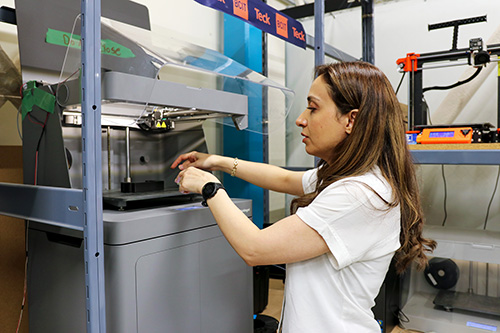
I’m excited about how additive manufacturing is evolving beyond prototyping toward producing functional, customized, and application-specific products. I’m particularly interested in the combination of advanced materials, manufacturing technologies, and biomedical and assistive applications.
At CARI, we have the opportunity to work closely with industry, healthcare partners, and students, which creates exciting opportunities to turn new technologies into practical solutions that can make a real difference.
What advice would you give to someone who wants to get involved in applied research?
Don’t be afraid of failure. In applied research, things often don’t work the first time, and sometimes the failures teach you more than the successful experiments.
I’d also encourage students to get involved in projects outside their comfort zone. You don’t need to know everything before you start. Applied research is very interdisciplinary, and some of the most valuable learning happens when you work with people who have different expertise from you.
About MAKE+
MAKE+ makes lives better through creative solutions driven by interdisciplinary applied research. By collaborating with local stakeholders, including industry, academic institutions, and students, MAKE+ develops groundbreaking technologies that make a real difference, enhancing lives and elevating British Columbia’s global competitiveness.
As the sole academic applied research group in Canada operating under the ISO 13485 (Medical Devices) Quality Management System, MAKE+ ensures a rigorous product development process. This user-focused innovation model leads to safe, effective, and market-ready products.