From improving restaurant reservations to supporting nonprofit housing and preparing businesses for AI adoption, BCIT students utilized artificial intelligence to help organizations solve real business challenges.
As part of the Business Information Technology Management (BITMAN) diploma in the BCIT School of Business + Media, students completed Business Consulting Projects (BCP) with industry partners across British Columbia. Working in teams over ten weeks, they investigated business challenges, developed practical solutions, and delivered recommendations organizations can build on long after the project ends.
This year’s cohort partnered with organizations across a range of industries. The projects highlighted below represent just a few examples of the consulting work students completed during the term.
“What makes BCP so distinctive is that students aren’t practicing consulting, they’re doing it,” says Shauna Begley, Program Head, Business Information Technology Management. “The work they produced this term made a genuine difference for the organizations involved, and that’s exactly the point.”
Developing an AI-readiness framework across operations
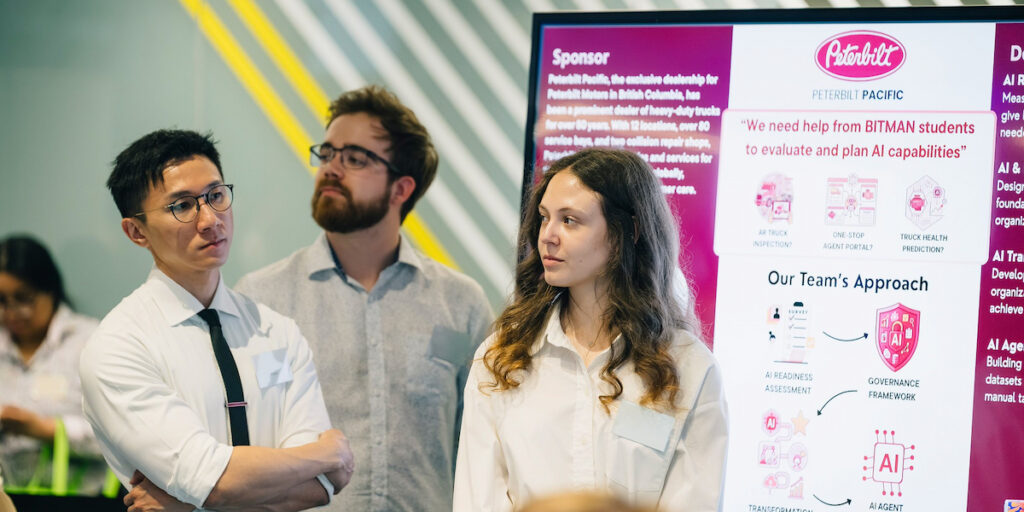
One team partnered with Peterbilt Pacific, BC’s largest specialized truck network, to help the company better understand what it would take to adopt AI across its operations.
The students developed an AI-readiness framework and data governance strategy tailored to the company’s needs. They conducted an organization-wide readiness assessment, created an AI demonstration to showcase future possibilities, and developed recommendations that addressed both technology and organizational readiness, including employee adoption and data management practices.
“The student team demonstrated a high level of professionalism, collaboration, and initiative,” says Paul Kroker, IT Manager at Peterbilt Pacific. “Their work on survey development, analytics, and data governance helped drive the project to a complete success.”
Using AI to improve the guest experience
Another team worked with Moxies Grill and Bar to explore how AI could help improve the guest experience. During busy service periods, restaurant staff were often focused on serving guests in person, making it difficult to answer incoming reservation calls consistently.
Students evaluated several AI-powered phone solutions before developing a proof-of-concept reservation agent capable of answering calls and assisting guests with bookings. They also designed an analytics dashboard to provide management with greater visibility into call volumes and booking trends while reviewing privacy and compliance considerations.
“You took a real operational challenge and turned it into a practical recommendation with clear business value,” says Anna Bouwers and Nevyas Subroto of Moxies Grill and Bar. “We appreciated the professionalism, effort, and fresh thinking the group brought throughout the project.”
Leveraging AI to enhance payment processors
Meanwhile, another student team partnered with FintechWerx, a company that helps businesses onboard with Canadian payment processors. The existing process relied heavily on manual data entry and document review, creating inefficiencies and delays.
After mapping the current workflow, the students identified opportunities to automate merchant intake, document verification, and compliance screening. Their recommendations included an AI opportunity assessment, a working prototype, and a 12-month implementation roadmap designed to improve efficiency while reducing manual work.
“We are pleased with the overall outcome and look forward to leveraging the work delivered by the BCIT team as we advance this critical initiative.” says George Hofsink, Co-Founder and CEO of FintechWerx. “The correlation between the original project brief and the outputs they produced was consistent throughout.”
Creating AI-assisted workflows that ensure privacy and governance
Students also collaborated with Red Door Housing Society, a nonprofit organization that has provided affordable housing across Metro Vancouver since 1985. Following a recent data digitization initiative, the Society wanted to explore how AI could improve operations while maintaining strong privacy and governance practices.
The team assessed existing processes and developed a technology roadmap centred on secure collaboration, document management, and AI-assisted workflows. They also created a proof of concept featuring a public FAQ chatbot, tenant and applicant portal, automated vacancy matching, and wait-list management workflows designed to keep sensitive information within structured and auditable systems.
“You’re really making it look the way I envisioned it. This is a good platform. I am super impressed,” says Bailey Mumford, Executive Director of Red Door Housing Society.
While each project addressed a different business challenge, they all shared a common goal: giving students the opportunity to apply their technical and business knowledge in a professional consulting environment.
Through Business Consulting Projects, students gain experience working directly with clients, managing stakeholder expectations, navigating privacy and compliance requirements, and delivering practical solutions to complex business problems. At the same time, organizations benefit from fresh perspectives and applied recommendations that can help support innovation and digital transformation.
“The projects demonstrate what happens when education and industry come together,” says Phil Ramer, Associate Dean, Operations Management. “Students leave with meaningful real-world experience, and our partners gain practical solutions they can continue to build on.”
Organizations interested in partnering with BCIT students can learn more about Business Consulting Projects through the BCIT School of Business + Media.