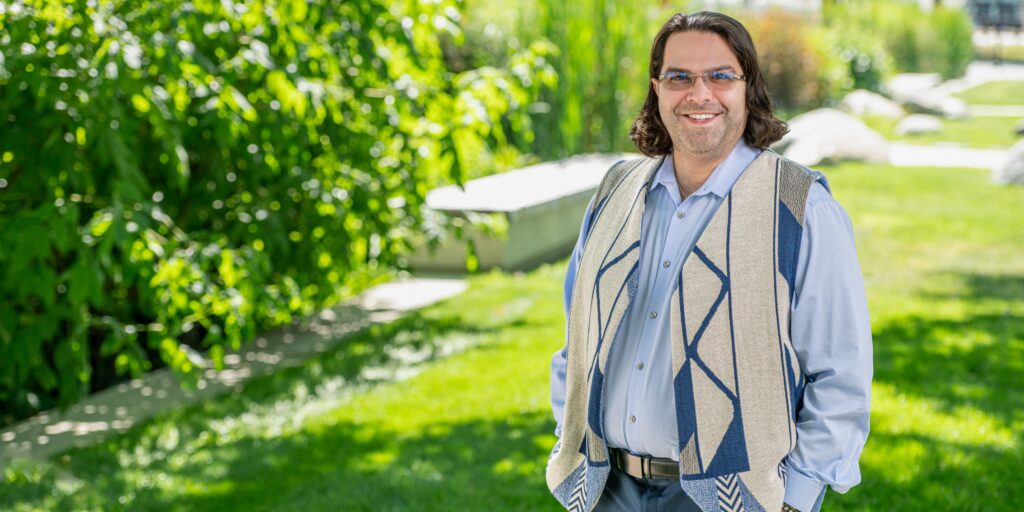
(This article is written by Troy MacBeth Abromaitis, a two-time BCIT alum in the Marketing Management (Professional Real Estate option) and Leadership Management, now known as Business Administration).
As Canada continues its journey toward Truth and Reconciliation, a growing movement is calling for June 30 to be recognized across the country as National Blanket Ceremony Day – Indigenous Survivors Day, a day dedicated to honouring Indigenous Survivors of child removal policies and practices while creating space for healing, reflection, understanding, and hope.
The observance was founded by Sixties Scoop Survivor Troy MacBeth Abromaitis, a member of Lytton First Nation within the Nlaka’pamux Nation, who envisioned a national day that would recognize not only Survivors of the Sixties Scoop but also Survivors of the Millennium Scoop, birth alerts, and the ongoing overrepresentation of Indigenous children within Canada’s child welfare system. While Canada has taken important steps to acknowledge the legacy of Residential Schools many Survivors felt there remained a need for a dedicated day that recognized the generations of Indigenous children who continued to be separated from their families long after the Residential School era.
“National Blanket Ceremony Day is ultimately about healing,” said Troy. “Healing for Sixties Scoop Survivors. Healing for families who were separated. Healing for communities that continue to carry intergenerational impacts. And healing for Canada as we continue our journey toward truth and reconciliation.”
For generations, Indigenous children were removed from their families, communities, cultures, and Nations through policies and systems that often failed to recognize the strength, love, and importance of Indigenous family structures. The impacts of those removals continue to be felt today by Survivors, their children, their grandchildren, and their communities. Yet behind every child who was taken was also a family whose story was forever altered.
Two Hearts Dreaming
For many Indigenous mothers, the loss of a child was not the result of a lack of love. Quite the opposite. Like mothers everywhere, they dreamed of a good life for their children. They hoped their children would be safe, healthy, and successful. Yet through systems that often misunderstood Indigenous families and communities countless children were separated from the people who loved them most. When people speak about the Sixties Scoop, they often focus on the child who was taken. Less often do they speak about the mother whose heart was broken, the grandparents who never stopped wondering, or the generations that lost a connection to one another.
“When people think about the Sixties Scoop, they often focus on the child who was taken,” said Troy. “But there is also a mother whose heart was broken, a family who spent years wondering where that child went, and generations who lost a connection to one another. National Blanket Ceremony Day honours those families too.”
This understanding lies at the heart of a concept that Troy describes as Two Hearts Dreaming. One heart belongs to a mother dreaming of a better life for her child. The other belongs to a child growing up searching for identity, belonging, and connection. Though separated by circumstances beyond their control both carry the same hope: to know one another, to reconnect, and to restore what was lost.
For many Survivors, healing begins when those two hearts find their way back to each other. It is through those reconnections that families rebuild, cultures are strengthened, and legacies continue. National Blanket Ceremony Day recognizes not only the journey of Survivors but also the enduring love of the families who never stopped waiting for them to come home. It is a recognition that family connection is more than a relationship—it is identity, culture, belonging, and legacy carried from one generation to the next.
The choice of June 30 is deeply significant
The choice of June 30 is deeply significant. Positioned immediately before Canada Day, the observance invites Canadians to pause and reflect on the country’s history before celebrating its future. It provides an opportunity to acknowledge difficult truths while embracing a future built on understanding, respect, and reconciliation.
For Troy, the date also carries a profoundly personal meaning. June 30 marks the anniversary of the devastating 2021 wildfire that destroyed much of the Village of Lytton and impacted the surrounding communities of Lytton First Nation. In the years that followed, Troy joined many others in supporting recovery and rebuilding efforts helping his Nation navigate one of the most difficult chapters in its modern history.
“The lessons are similar,” said Troy. “Whether it is a community rebuilding after a wildfire or Survivors rebuilding after separation from family and culture healing begins when people come together, support one another, and refuse to give up hope.”
For him, the connection between the two events is profound. Both speak to loss, resilience, healing, and the determination of Indigenous communities to rebuild and move forward. Just as Lytton continues its journey of recovery National Blanket Ceremony Day seeks to support the healing journeys of Indigenous Survivors and their families across Canada.
For Troy, the rebuilding of Lytton became more than a professional commitment. As a community builder and real estate development professional, he returned home to help his Nation during a time of extraordinary need. In doing so, he found something he had spent much of his life searching for—a deeper connection to family, culture, and community. Through Elders, relatives, and community members he learned what it meant to serve others and to approach leadership, community-building, and reconciliation in a good way.
That journey reached a defining moment when members of his Nicomen family welcomed him home through a traditional Blanket Ceremony and honoured him with an ancestral name. For Troy, the experience represented belonging, acceptance, responsibility, and a return to family. The ceremony became the inspiration for National Blanket Ceremony Day and its central message that every Survivor deserves the opportunity to reconnect with family, community, culture, and identity. “The Blanket Ceremony changed my life,” said Troy. “It helped me understand the power of being welcomed home. I wanted other Survivors to know that they belong too.
A national movement of healing, belonging, and reconciliation
Inspired by that homecoming, Troy began carrying the message of Indigenous Survivors Day across the country. Guided by the teachings he received from Elders and family, he shared the vision with municipalities, provinces, territories, Indigenous Nations, Members of Parliament, Senators, and national Indigenous organizations. He brought the conversation to leaders wherever he was welcomed, including the Assembly of First Nations, advocating for a national commitment to honour Indigenous Survivors and their families. In many ways the work became an extension of the Blanket Ceremony itself—a journey of building relationships, creating understanding, and inviting communities across Canada to walk together in the spirit of healing, belonging, and reconciliation.
At the heart of the observance is the Blanket Ceremony. Across many Indigenous cultures, blankets symbolize honour, protection, belonging, and love. They are gifted during important milestones and ceremonies as expressions of respect, care, and connection. National Blanket Ceremony Day embraces the blanket as a symbol of return—a reminder that every Survivor belongs and that every family connection matters.
“By placing Indigenous Survivors Day on June 30, Canadians have an opportunity to reflect before they celebrate Canada Day and remember the children who were taken and why this history matters,” said Troy. “Reflection and celebration can exist together. Understanding our full history makes us stronger as a country.”
The movement has continued to gain momentum across Canada. Provinces, municipalities, Indigenous Nations, educational institutions, and community organizations have begun recognizing the day through proclamations, ceremonies, educational initiatives, sacred fires, and community gatherings. Supporters hope the observance will eventually be recognized by every city, every province, every territory, every Indigenous Nation, and ultimately by the Government of Canada.
Creating a space where healing can occur
Among those supporting the movement is David Wilkinson-Simard, a Sixties Scoop Survivor, traditional knowledge keeper, and member of the City of Thunder Bay’s Indigenous Advisory Council. During Thunder Bay’s recognition of Indigenous Survivors Day Wilkinson-Simard led a sacred fire and offered closing reflections for the community gathering.
“It’s an opportunity to help Canadians understand why many things are the way they are today and how First Nations continue to move forward and heal,” said David. “It is an opportunity for people to learn, reflect, and better understand the challenges Indigenous families have faced and overcome.”
His words reflect the broader purpose of National Blanket Ceremony Day. It is not about assigning blame. It is about fostering understanding. It is about recognizing resilience. It is about acknowledging loss while celebrating survival. Most of all it is about creating a space where healing can occur—not only for Survivors and their families but for a country still working toward reconciliation.
Supporters believe one of the strengths of National Blanket Ceremony Day is that it focuses not only on what was lost but also on what survived. Despite decades of separation many Survivors have found their way home, reconnected with family, reclaimed their cultures, and become leaders within their communities. Their stories are not only stories of loss; they are stories of resilience, perseverance, and hope.
“This is not about reopening wounds,” said Troy. “It is about creating space for healing. It is about recognizing Survivors for their resilience and helping Canadians understand that these stories are not simply history. Many families continue to live with these impacts today.”
As recognition continues to expand supporters envision a future where June 30 is observed in every corner of the country as a shared moment of reflection and healing. They hope it will become a day when Canadians pause to remember the children who were taken, honour the Survivors who endured, celebrate those who found their way home, and recommit themselves to ensuring that future generations of Indigenous children remain connected to their families, cultures, languages, and Nations.
“Every Survivor carries a story,” said Troy. “Some are stories of loss, some are stories of return, and many are both. This day honours all of those journeys. It reminds Survivors that they are not forgotten and that they belong.”
National Blanket Ceremony Day is ultimately about connection—the connection between a mother and a child, a Survivor and their family, generations separated and reunited, and a country striving to reconcile with its past while building a better future.
It is healing for Sixties Scoop Survivors. It is healing for families. It is healing for communities. And it is healing for Canada.