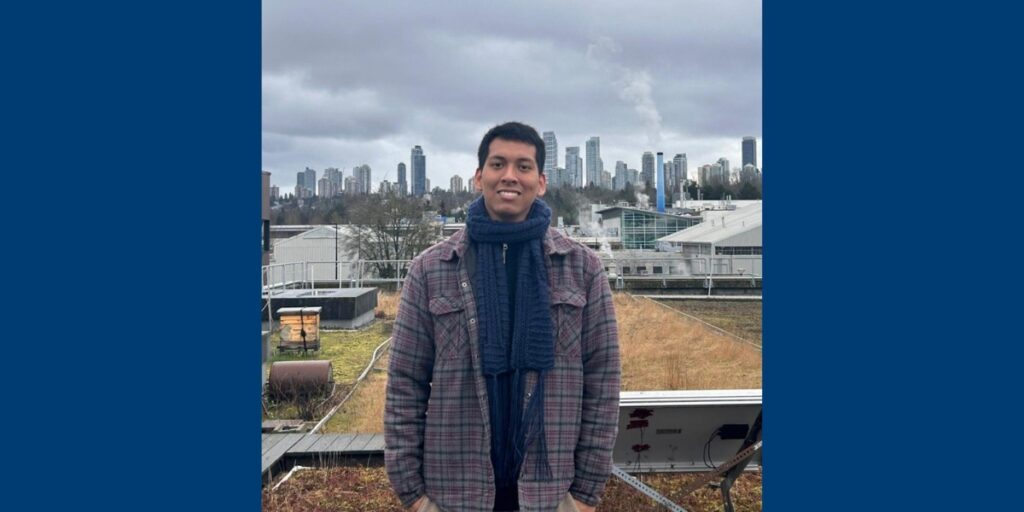
Rodrigo Ramirez, a Master of Applied Science (MASc) in Building Science student at BCIT, recently presented his research on blue-green roofs at the International Institute of Building Enclosure Consultants (IIBEC) conference. An international student from Peru with a background in civil engineering, Rodrigo shared his work with an audience of building enclosure professionals, designers, and contractors from across the industry.
His research examines blue-green roof systems, which combine vegetation with water-management layers to help buildings better respond to environmental pressures such as heat and stormwater management.
Turning research into industry conversation

At the conference, Rodrigo focused on helping practitioners understand what blue-green roofs can—and cannot—do. Often referred to broadly as “green roofs,” these systems are more complex than they appear. They are carefully designed assemblies that include vegetation, growing media, and water-retention layers working together as a system.
“Think of it as a garden on a roof,” Rodrigo says. “But one that’s designed intentionally. Each layer has a job, from managing moisture to controlling drainage.”
While blue-green roofs can help reduce roof surface temperatures, slow stormwater runoff, and support biodiversity, Rodrigo emphasized the importance of adopting coordinated solutions.
“These systems are not a cure-all for sustainable design challenges, but one tool among many,” he says. “As cities move toward tighter environmental targets, we’re going to see more solutions that try to address multiple goals at once,”
He adds, “Blue-green roofs sit at the intersection of heat, water, and ecology. That makes them important to understand, especially before they become more widely used.”
The opportunity to present at IIBEC was made possible because of industry connections to the research project, as well as the support of BCIT Building Science Program Head Dr. Rodrigo Mora.
Rodrigo says those partnerships were key, not only in opening the door to the conference, but in grounding the research in real-world practice rather than theory alone.
Choosing building science at BCIT
Rodrigo’s path to building science began near the end of his civil engineering degree, when he realized he wanted to move beyond traditional design and construction roles. He became increasingly interested in how buildings affect people’s everyday lives—and how building performance influences comfort, health, and energy use.
Discovering building science reframed how he viewed the built environment. “It introduced the idea that buildings are dynamic systems,” he says. “Heat, air, moisture, and acoustics aren’t just technical details. They shape how people experience a space.”
That perspective led him to BCIT and to Dr. Mora’s research. “After a few conversations, everything clicked,” Rodrigo says. “BCIT offered the applied, systems-based approach I was looking for.”
Working closely with Dr. Mora has shaped his growth as a researcher. Ramirez credits his supervisor with encouraging rigor, curiosity, and confidence, while emphasizing the importance of testing assumptions with real data. “You learn to be careful with conclusions,” he says, “but still bold about the questions you ask.”
As cities continue to grapple with climate pressures and performance expectations, Rodrigo sees building science research playing a critical role. “The industry often adopts solutions faster than it understands them,” he says. “Research helps make that transition responsible.”
For Rodrigo, presenting at IIBEC was one step in that process, bringing BCIT-led research into the spaces where future buildings are shaped.
Learn more about the Building Science master’s degree programs.