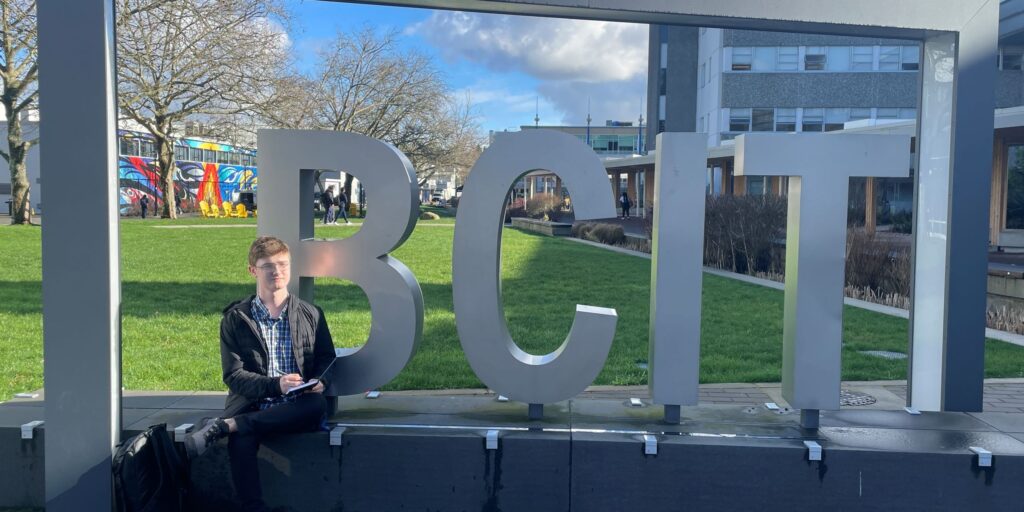
I am Thomas Adams, a Broadcast and Online Journalism student in the BCIT School of Business + Media. In addition to my full-time studies, I am also a BCIT Flexible Learning student taking an online Accounting course on Monday evenings.
After graduating from high school, I was unsure of what to do but I knew I wanted to step away from the traditional routine and focus on learning topics that truly interest me. Flexible Learning at BCIT gave me the opportunity to do exactly that – a flexible pathway to explore my interests and build direction for my future, at my own pace.
While the transition was a big change and took some time to adjust to, it ultimately opened me up to a world of possibilities. Over the past three years, I have taken 12 Flexible Learning courses – ranging from Marketing and Statistics to Economics – and they have all taught me more than I expected.
Here are some of learnings and tips for anyone considering BCIT Flexible Learning:
1. Know how your class is delivered
Flexible Learning is one of the most interesting forms of education as classes can be delivered in a multitude of different ways. Some classes may be held in-person, some online, and some a hybrid of both.
One of my early learning experiences was knowing when and how my courses were going to be taught to me. In my first year, I enrolled in Microeconomics which was a hybrid course. This meant that every week, the class would alternate between in-person and online delivery.
Although I initially missed the first two classes due to a misunderstanding of the hybrid schedule, I was able to quickly get back on track for the course.
The important thing is to read the course outline ahead of time to clarify how and when the course is going to be taught. If you can’t find this information, check the BCIT registration page or email the course administrator directly. I have found that they are very good at getting back to you.
2. Reach out to instructors
It’s a little bit of a transition coming from high school right into Flexible Learning. Depending on the course format, you may only get to see your instructor in-person once a week or fully online.
During my first year in Flexible Learning, I was nervous to speak up or ask any questions as I didn’t want to come across as unfamiliar with the subject matter.
Although it might seem that there’s a barrier between instructors and students, this couldn’t be further from the case. My instructors have always been very enthusiastic in answering questions and supporting my educational journey. It’s refreshing to learn from instructors who are industry experts and know what challenges we might face in our careers. One of my Marketing teachers was the former Head of Marketing at Vancity. He was able to pull situations he faced in his career to help the class learn about course topics.
Simply asking questions about instructors’ work experience opens a huge insight into the profession you may want to go into. You will learn 10 times more than you thought if you get to know your instructors and what their jobs were like.
3. Designate time for coursework
This one may seem quite simple, however I cannot overlook its importance. In my first year, (and still now honestly), I find myself falling behind in coursework amongst the other things I have going on in my life.
For almost every class that I have had through Flexible Learning, homework is due every week. However easy it might be to procrastinate, I strongly recommend getting the homework done as soon as possible. Don’t leave your learning to the last minute!
Every single week, I have regretted not reading a chapter ahead. When instructors ask if there are any questions, it’s more valuable to ask informed and meaningful questions because you are knowledgeable on the topic before the lesson. It makes for some stressful studying when it’s a week before the exam and instead of reviewing the chapters, you are learning them all for the first time.
I know schedules are busy and the nice thing about Flexible Learning is the fact that you can do schoolwork when it suits you best. However, you will be thanking your past self if you decide to stay on top of your coursework, week-by-week.
4. Connect with others
Going into a new phase of life is never easy. Meeting new people is a practice that many seem to hide from these days. Flexible Learning can feel a bit isolating at times, especially when you only see your classmates about once a week.
I was hesitant to talk to others in my first year. I had come from knowing everyone in my high school to a much different environment. It took me a little while to open up and talk to the people who sat next to me in class. However, when they started talking to me, I realized that they were some of the best connections I could make in my post-secondary journey. Many of my classmates are also working professionals who have returned to school to advance their skills.
You may be pleasantly surprised about how similar you are to your classmates. They are taking the same classes as you and are likely following a comparable route. Having a peer to talk to and help you out with coursework makes the classes much more fun and engaging.
5. Embrace flexibility
BCIT Flexible Learning is a great post-secondary option for learners who want to upgrade their skills while balancing competing priorities in life. I originally chose it to switch up my high school routine. For me, this meant being able to get a part-time job, waking up a little later in the day, and doing coursework when it suited me.
A flexible pathway to support your career goal
Are you looking to work full-time and take classes on the side? Flexible Learning offers that to students.
Are you living abroad and still looking to continue your education? That is now a possibility.
Are you looking to do a volunteer opportunity on the other side of the world in the middle of a semester but still looking to continue your education? That’s what I’m planning to do this summer.
There really are no bounds to Flexible Learning as long as you’re willing to put in the work. You’re in control of your own life now. Different forms of classes, whether they’re in-person, online, or hybrid, will allow you to build a schedule that works for you.
LEARN MORE: BCIT Flexible Learning, with spring/summer term course registration opening on February 18 at 9am.